

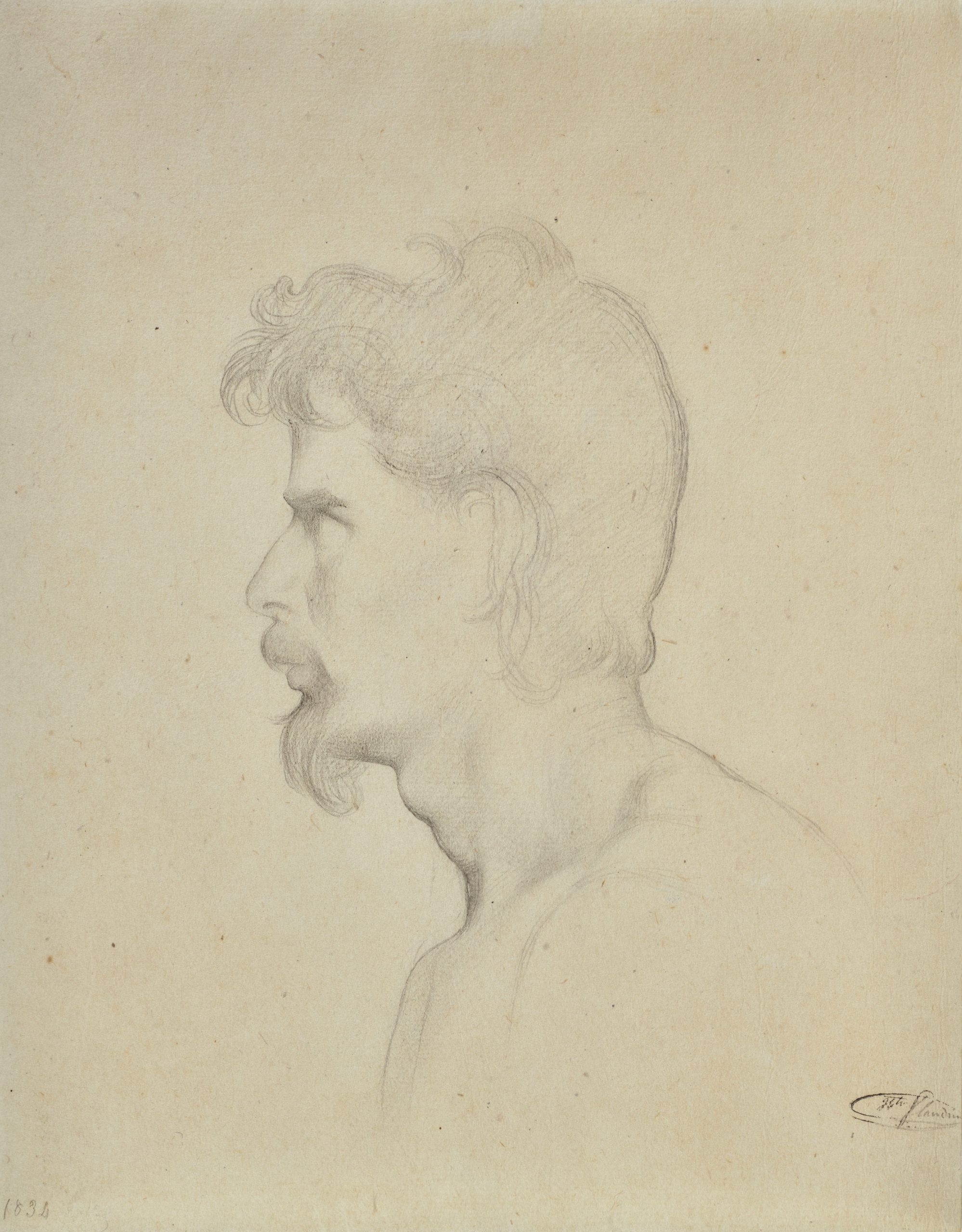
(1809 Lyon – Rome 1864)
Portrait of a Man in Profile
Graphite
295 x 235 mm
Dated lower left: 1834
Studio sale stamp, lower right (Lugt 933)
Born into a family of artists alongside Auguste and Paul, Hippolyte Flandrin, born in 1809, was undoubtedly Ingres’ most brilliant pupil. He worked in all genres, but it was through his portraits and religious paintings that he gained fame.
His encounter with Jean-Auguste-Dominique Ingres (1780–1867) proved decisive for his career. In Lyon, he attended Pierre Révoil’s studio alongside his brother Paul (1811–1902), who encouraged them to move to Paris. In 1829, the two brothers arrived in the capital and initially considered joining the studio of Louis Hersent. However, a friend, Guichard, advised them to make contact with Ingres, then a rising figure in the art world. Paul and Hippolyte Flandrin joined the master’s studio, where he quickly grew fond of the two brothers.
Hippolyte’s fate remained closely linked to that of his brother Paul. But while Paul devoted his art to landscapes and portraits, Hippolyte, a devout Catholic, dedicated himself to religious painting. In 1832, he won the Grand Prix de Rome, while Paul was unsuccessful. This did not prevent them from reuniting in the Eternal City—especially since Ingres had become director of the Villa Medici. During this stay, Hippolyte formed a friendship with another resident of the villa: the architect Victor Baltard (1805–1874). Upon their return to Paris in 1838, the two Flandrins brilliantly applied their master’s lessons, drawing inspiration from Italian Renaissance models, Raphael above all.
One of Hippolyte Flandrin’s most famous works is undoubtedly The Young Man Seated by the Sea, executed in Rome in 1836.
In 1840, his series La Florentine (museums of Nantes, Évreux, Beauvais) paid a marked tribute to Raphael and Leonardo da Vinci. Closely connected to the Count of Feltre, who donated his collection to the city of Nantes, Hippolyte Flandrin was commissioned to produce works for his patron, such as La Rêverie, painted in 1846, which reveals a more intimate facet of the artist’s talent as a colorist. In the same vein, in 1842 he painted an extraordinary Double Self-Portrait with his brother Paul, capturing with rare tenderness the enduring artistic bond between the two siblings.
In Paris, Hippolyte Flandrin made a groundbreaking contribution to religious painting. After completing The Last Supper for the Saint-Jean chapel in the church of Saint-Séverin in 1842, he undertook, from 1842 to 1864, at the request of his friend Victor Baltard—who was responsible for decorating Parisian churches—the entire mural decoration of the church of Saint-Germain-des-Prés. He chose to create a dialogue between scenes from the Old and New Testaments as a guiding principle, leaving behind a body of work hailed as a model of religious decoration. He was assisted in this endeavor by his brother Paul, who is credited with portraying Christ in the likeness of Hippolyte in the sanctuary paintings facing each other—The Entry into Jerusalem (south) and The Ascension to Calvary (north)—and with painting the final four scenes of the two western bays on the south side of the nave, while Hippolyte’s brother, suffering from illness, went to rest in Rome.
Our striking drawing, dated 1834, was executed in Rome and almost certainly takes as its model an artist friend of Flandrin at the academy. As often, the artist emphasized the line of a strict profile, as he also did the same year in the very fine Polytes, Son of Priam, Observing the Movements of the Greeks.
Hippolyte Flandrin, whose drawings were always extremely delicate, drew their strength from the purity of his line and the subtle contrast between a dark contour sharply defining the profile and the use of shading. The gaze of our model thus appears both fixed and mysterious.
Flandrin retained this highly recognizable style throughout his career. Our portrait can be compared to a study sheet for the figure of Judas for the nave of the church of Saint-Germain-des-Prés, executed around 1859—more than 20 years after our drawing. The profile is remarkably similar.