

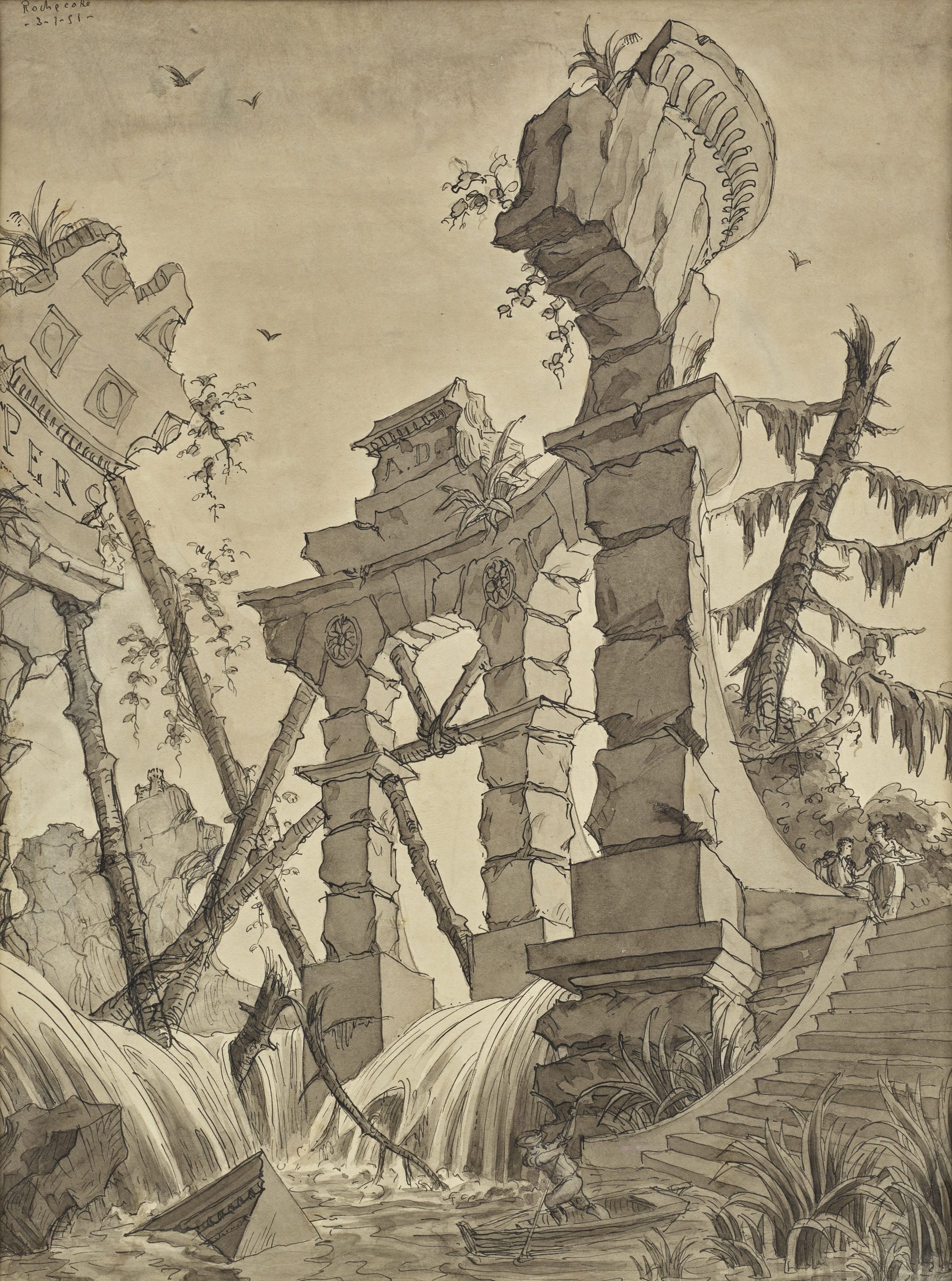
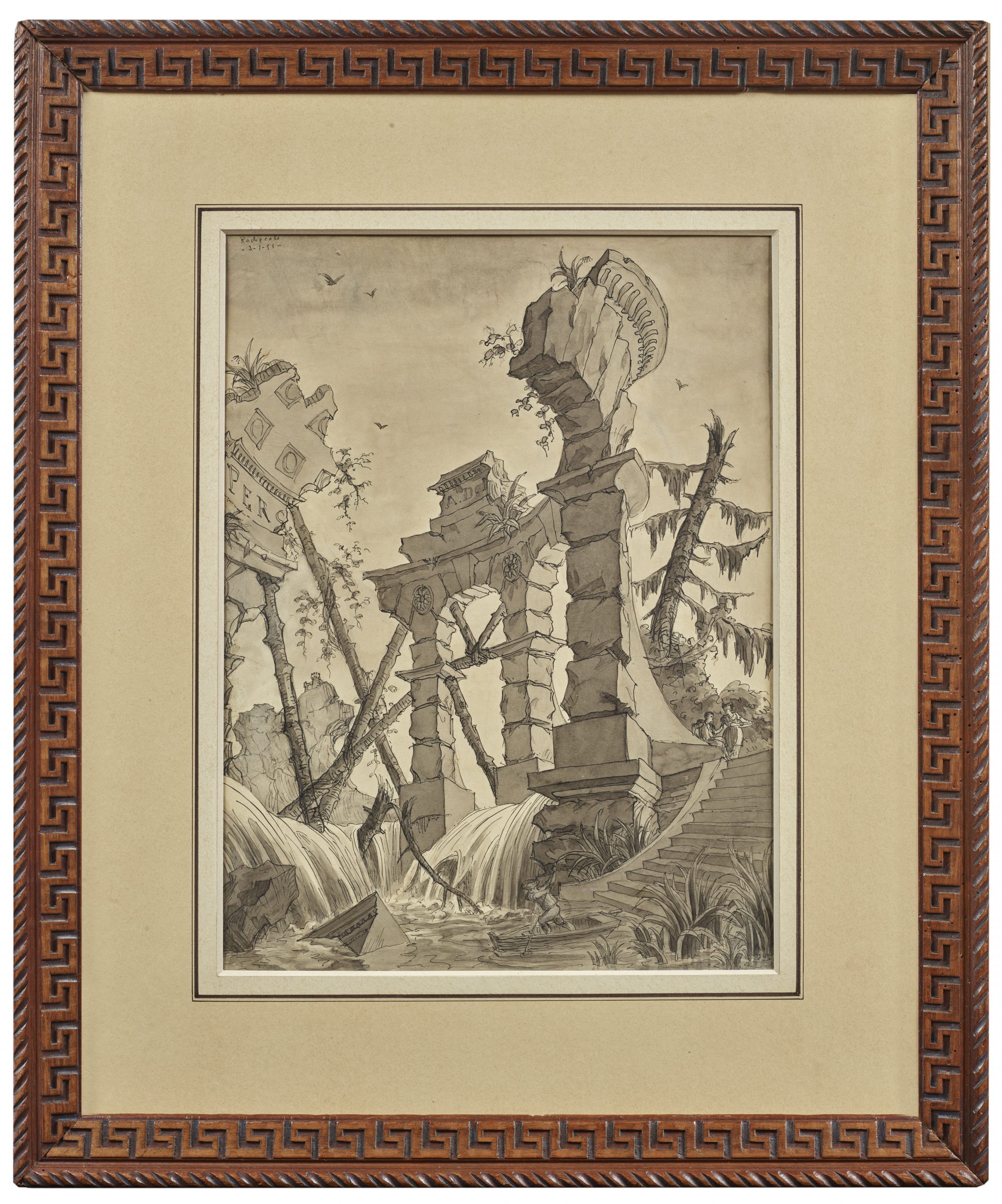
(1890 Paris 1969)
Imaginary Ruins
Pen, black ink, and sepia ink wash on paper
415 x 315 mm
Inscribed and dated upper left: Rochecotte / – 3 – 1 – 51 –
Emilio Terry was born in the 16th arrondissement of Paris into a wealthy family of Cuban origin. His father, Francisco Javier Terry, purchased the Château de Chenonceau for just over one million francs in 1896, and the estate became the family’s secondary residence. The intense historical and dreamlike atmosphere in which the future artist was immersed from a young age likely explains his assured taste for architecture, interior design, and classical culture.
Emilio Terry was a member of the Café Society and one of those influential artists highly prized by intellectual circles, counting among his friends Jean Cocteau, Christian Bérard, Jean Hugo, Alberto Giacometti, Salvador Dalí, and Jean-Michel Frank.
Terry deployed his creativity across architecture, furniture design, and interior decoration. He was commissioned by numerous patrons, such as François de Gouy, to design—with the collaboration of Pablo Picasso and Jean Hugo—certain rooms at the Château de Clavary near Grasse, as well as furniture, including a console inspired by the holy water font sculpted by Jean-Baptiste Pigalle for the church of Saint-Sulpice in Paris. Another notable project was the neoclassical townhouse at 5 rue Gambetta in Boulogne-Billancourt, commissioned in 1932 by his friend Gilbert Blanchard des Crances, which later became the residence of Édith Piaf and Marcel Cerdan in the 1940s.
The modernity and distinctly classical inspiration evident in Terry’s creations, particularly his furniture, earned them the label “Louis XVII style,” bridging the gap between Louis XVI furniture and 20th-century decorative arts.
Among his projects, the most ambitious was undoubtedly the renovation and restoration of the Château de Rochecotte in Touraine, carried out over more than thirty years—the very place where our drawing was made. The château belonged to Terry’s brother-in-law, Stanislas de Castellane, who sold the estate to the artist in 1934. Terry devoted himself to restoring the site’s charm while integrating 20th-century artistic sensibilities without compromising its historic character.