

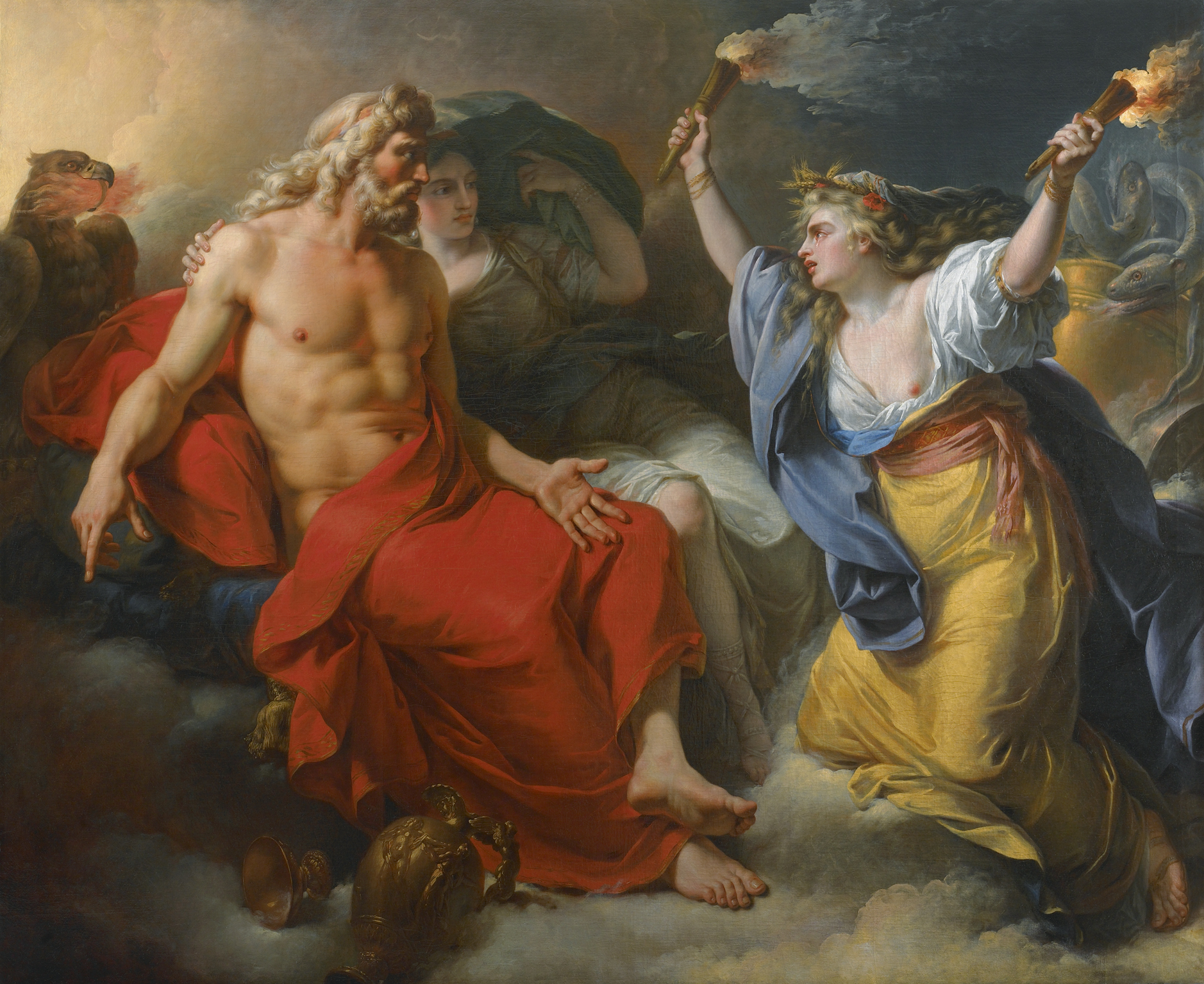
Ceres imploring Jupiter’s lightning after the abduction of her daughter Proserpine
Oil on canvas
200 x 250 cm
A piece of entertainment by the artist, in 1777
Exhibition: Salon of 1777 (not listed in the catalogue, known through the sketch by Saint-Aubin and through reviews)
Related Works: Oil sketch (Musée des Beaux-Arts, Quimper), two preparatory drawings (Ecole Nationale Supérieure des Beaux-Arts, Paris); one preparatory drawing (Metropolitan Museum, New York)
Museum of Fine Arts, Boston
This newly rediscovered painting, doubly remarkable for its beautiful proportions and its historical significance, turns out to be a masterpiece by the painter Antoine-François Callet. The year is 1777, and the artist, then 36 years old, is already a well-known and respected painter. Far from being a beginner, Callet has already been honored with prestigious commissions, such as the frescoed ceiling in the Palazzo Serra in Genoa (1773) and the dazzling decoration of the Salon de Compagnie in the Palais Bourbon (1774). It is an artist at the height of his powers who presents, outside the catalogue, a canvas of great mastery in its conception, technique, and color.
The highly elaborate composition is the culmination of a long period of reflection, the development of which can be traced through four known or documented preparatory drawings and a painted sketch held at the Musée des Beaux-Arts in Quimper (Silguy Bequest, oil on canvas, H. 0.31; W. 0.42). In 1993, we devoted a short article ( Revue du Louvre et des Musées de France , no. 2, 1993, pp. 52–58) to the rediscovery of this preparatory sketch for Callet’s decorative piece, which was then held under an incorrect attribution.
Through this sketch, we were able to rediscover the memory of a pivotal painting we thought lost forever. Comparing the sketch with the final painting reveals that while the composition is already perfectly aligned in the sketch, the painter imbues the figures of Jupiter and Juno in the final version with an imposing majesty they lacked in the preparatory work. The figure of Ceres, essential to understanding the subject, appears agitated by passion, her face bathed in tears, a highly theatrical disarray. It is these two majestic figures of the divine couple that lend the work its commanding solemnity, its restrained tone, the hallmark of the « grand genre, » characteristic of the art of the second half of the 18th century , of which Callet quickly established himself as one of the greatest exponents. Critics were not mistaken in describing Callet’s painting as « grand in form. »
At the height of his virtuosity in the years 1775-1780, Callet also displays here a particularly dazzling technique, both in the fine glazes of the sensual renderings of skin, especially that of Jupiter’s muscular body, and in the silky precision of Ceres’s blond, curly hair or Jupiter’s half-white, half-blond hair, rendered with as much care as realism. The artist works with beautiful impasto, thus giving full relief to the dazzling whites of Ceres’s sleeves and, later, knows how to lighten his brush in an illusionistic rendering of the clouds. Finally, the color, monochrome and golden in the small sketch in Quimper, asserts itself here in superb contrasts of golden yellow, blue, bright red, and rosy red on the same figure of Ceres, thus giving even more vigor and agitation to the distraught goddess. In contrast, it is answered by the single red of Jupiterian power subtly associated with a deep blue.
Here we have, in both spirit and form, an example of a masterfully successful painting which brilliantly demonstrates, as one of the critics of the Salon of 1777 noted, how much « Mr. Callet (…) is the one (of all the artists of the Salon) who announces the most soul and fire. »
Brigitte Gallini
March 2008