

(1645 Toulouse – Paris 1730)
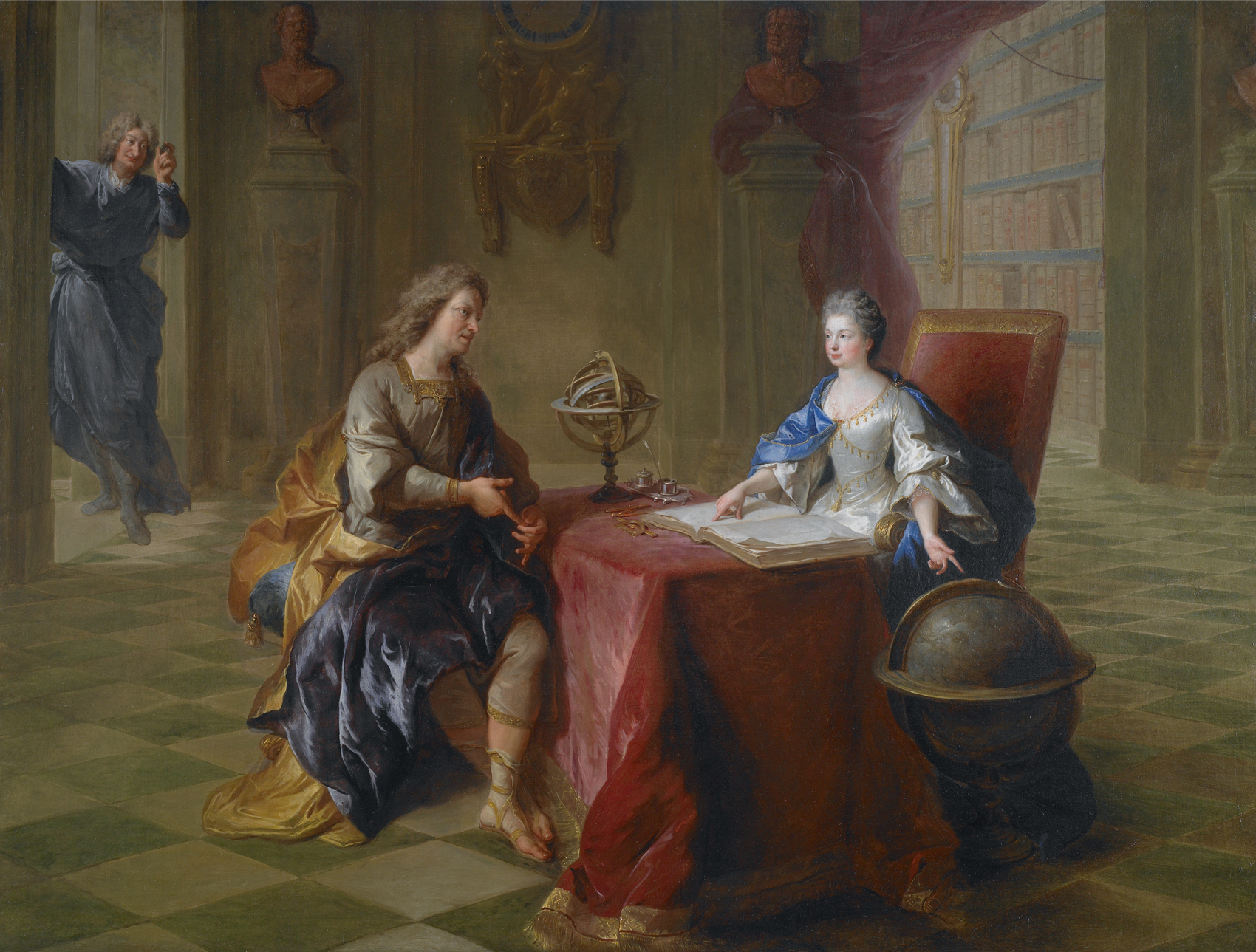
The Duchess of Maine’s Astronomy Lesson
Oil on canvas
99.5 x 130 cm
Executed around 1705
Origin:
Painted by the artist for one of the models, perhaps the version cited in the inventory of Sceaux; Count of Labessière, who sold it to the last owner in 1957.
Wadsworth Atheneum Museum of Art.
Just like Jean-François de Troy’s The Reading of Molière , our painting is one of the most emblematic interior scenes of the first half of the 18th century in France. The composition was previously known from another version, also by the artist (although not showing the numerous pentimenti existing on our painting, and of a less free execution in the drapery), acquired in 1988 by the Musée de l’Île-de-France in Sceaux (oil on canvas, 96 x 128 cm).
Apart from their pictorial quality and historical interest, these two paintings are the only known representations of the interior of the old Château de Sceaux, destroyed in 1790 (plans of which from the 17th and 18th centuries are preserved in the Nationalmuseum in Stockholm), and which experienced its golden age between 1702 and 1715, thanks to the brilliant personality of the Duchess of Maine (see François de Troy , Dominique Brême, Somogy, 1997, p.55 to 65).
The estate had been acquired in 1699 by the Duke of Maine from the widow of Marquis Jean-Baptiste Colbert de Seignelay, the son of Jean-Baptiste Colbert, the famous finance minister of Louis XIV.
The three figures in the scene are depicted here in the Duchess’s apartments, located on the south side of the ground floor, in the public area accessible from the main entrance. This is likely Colbert’s former study, whose antique busts, present in our painting, were already mentioned in earlier descriptions. To the right, the room opens onto a library, adorned with a barometer. The clock, whose face is supported by figures of Time and Love, was added by the Duchess. Her coat of arms, as well as that of her husband, can be seen between the two brackets.
François de Troy’s relationship with the Duke of Maine began as early as 1691, with a first portrait of the Duke in the company of his sister, Mademoiselle de Nantes. He subsequently produced several other portraits, including one documented in Dresden around 1692, two others known only through engravings by Drevet, and finally a last one, dating from 1715, which is kept at the Musée de l’Île-de-France in Sceaux.
Regarding depictions of the Duchess of Maine by de Troy, we know of only one: an allegorical portrait of the Duchess as Cleopatra (Versailles, National Museum of the Palace), of which several copies and replicas are recorded. De Troy also painted their son, Louis-Auguste, at least three times; the first portrait was exhibited at the Salon of 1704, the second, from 1712, is kept at the town hall of Trévoux, and the last is now known only through its engraving by Desrochers.
Our painting, with its exceptional richness of color, skillful design and inventive composition, allows us to enter the intimacy of the Duchess of Maine’s apartments.
Anne-Louise Bénédicte de Bourbon-Condé (1676-1753), granddaughter of the Grand Condé, known as Mademoiselle de Charolais, was the daughter of Henri-Jules de Bourbon, Prince of Condé, and Anne of Bavaria. She married Louis-Auguste de Bourbon, Duke of Maine (1670-1736), legitimized son of Louis XIV and the Marquise de Montespan, on March 19, 1692.
A preparatory drawing for the Duchess of Maine was sold at auction (F. de Troy, Portrait of a Lady Seated in an Armchair Holding a Book Before Her , Drouot, April 18, 1984, lot 81). It allows us to know with certainty de Troy’s working methods, who used a model for the pose, only having the Duchess actually pose for the study of her face.
The Duchess of Maine is easily recognizable here by her small stature (the Palatine described her as being « no taller than a ten-year-old child »), her large mouth, and her makeup, often described as excessive. She wears a satin dress adorned with gold embroidery, as well as a blue silk velvet cloak with fleur-de-lis motifs, a testament to her rank. With one hand, she points to a large book placed before her, near an armillary sphere indicating the positions of the sun and planets, and copper measuring instruments such as a protractor and compass.
Seated opposite her, on a stool rather than an armchair to emphasize the difference in their social standing, was Nicolas de Malézieu (1650-1729), a key figure at the court of Sceaux. A Hellenist and mathematician, he was the tutor of the Duke of Maine, to whom Bossuet had introduced him. A member of the Royal Academy of Sciences and author of Elements of Geometry (1715), he was passionate about the study of the stars and had an observatory installed at his home in Châtenay for his astronomical research.
Depicted here counting the planets (thus echoing the gesture of the Duchess of Maine, who was pointing to a celestial sphere), he was also a man of letters and was elected to the French Academy in 1701. A translator, author of poems, tales, and short plays which he performed himself, he organized theatrical and musical evenings in Sceaux. A number of his works were published in 1712 in * Les Divertissemens de Sceaux*.
He is depicted here in ceremonial costumes, certainly to show how scientific studies and festivities followed one another at this court.
Malézieu is easily recognizable by his long nose, his bulging eyes and the depression he had on his forehead, as can be seen on the portrait engraved by Edelinck (BNF, Cabinet des Estampes, Db 14 + , f°36) after the painting by François de Troy exhibited at the salon of 1704, and now lost (a copy of this portrait is kept at the Palace of Versailles, MV.2946).
Famous for his poor eyesight, Malézieu had received the nickname « Eye-poor », as Abbé Genest, the last figure in our picture, reminds us, appearing on the threshold of the door holding a magnifying glass.
Charles-Claude Genest (1639-1719), factotum at the court of Sceau, had been an officer before becoming an abbot. A member of the French Academy (1698), like Malézieu, he was described by Sainte-Beuve in his Monday Chats as follows : « Abbot Genest was to princes what they have always loved (even in our time), a mixture of poet and jester. » (vol. 3, Garnier, Paris, 1858, p. 213).
Among the most prominent figures at this court were Abbot Guillaume Amfrye de Chaulieu, Joseph La Grange-Chancel, and later, Voltaire, who wrote Zadig at the Château de Sceaux. Other notable figures included Montesquieu, d’Alembert, and the Count of Caylus.
Our painting, along with the spectacular and ambitious Banquet of Dido and Aeneas (Salon of 1704), recently acquired by the Musée de l’Île-de-France, is the most important commission given to de Troy for Sceaux. (In addition to the Duke and Duchess, some members of their court are also depicted in the banquet, including Malézieu and Abbé Genest.)
Apart from our painting and the one in the Musée de l’Île-de-France, another version of the painting is known (see La Leçon d’Astronomie de la duchesse du Maine , by Georges Poisson, in La Revue du Louvre, 1989-4, p. 242, and p. 244, note 23). Described as a lesser replica in the article, this one has remained in Malézieu’s descendants.
Biography:
A pupil of his father, Jean de Troy, François de Troy completed his training in the workshops of Nicolas Loir and Claude Lefèbvre. Settling in Paris after 1662, he was admitted to the Royal Academy in 1674 with his paintings of Mercury and Argus (Paris, École Nationale des Beaux-Arts). Under the patronage of the financier Pierre Crozat, like himself from Toulouse, François de Troy became one of the most highly regarded portrait painters at court, on par with Rigaud and Largillière, who were a few years his junior.
Among the important commissions that marked his career were The Birth of the Duke of Burgundy , painted for the Aldermen of the City of Paris in 1682; portraits of Mademoiselle de Nantes (1690; Chantilly, Musée Condé), the Count of Toulouse or Mademoiselle de Blois (1691; Paris, Musée du Louvre); and the Princess of Conti (Versailles, Musée du Château). De Troy also left us the portrait of Mansart (1699; Versailles, Musée du Château) and that of the collector Jean de Julienne (1722; Valenciennes, Musée des Beaux-Arts).
Many of his drawings, considered by Dezallier d’Argenville to be on par with « those of Van Dyck, » have survived to this day. Alongside his work as a painter, François de Troy pursued an official career at the Royal Academy, becoming its director in 1708 and then assistant rector in 1722. His son, Jean-François de Troy (1679 Paris-Rome 1752), was one of his pupils.