

(1667 Toulouse 1735)
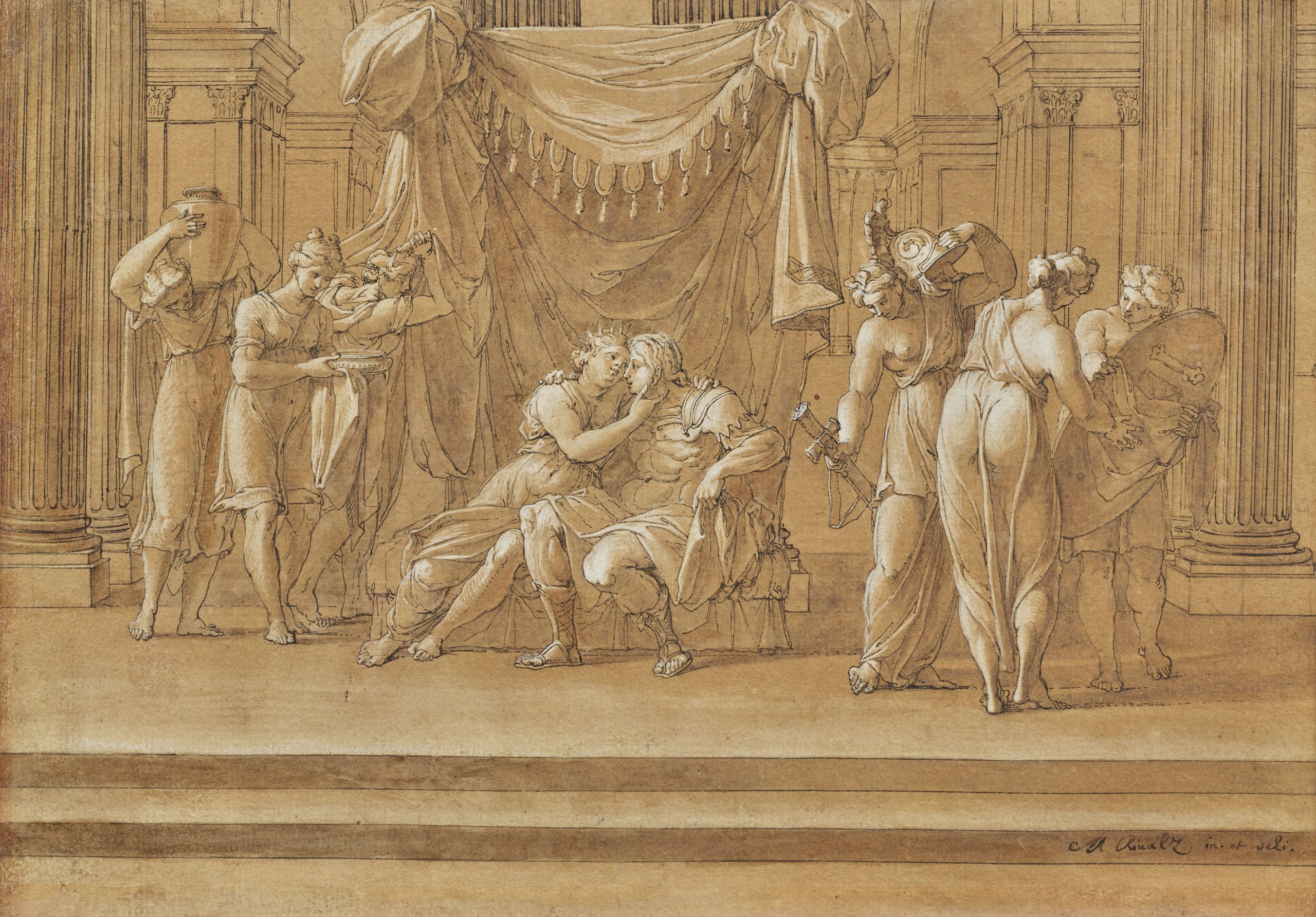
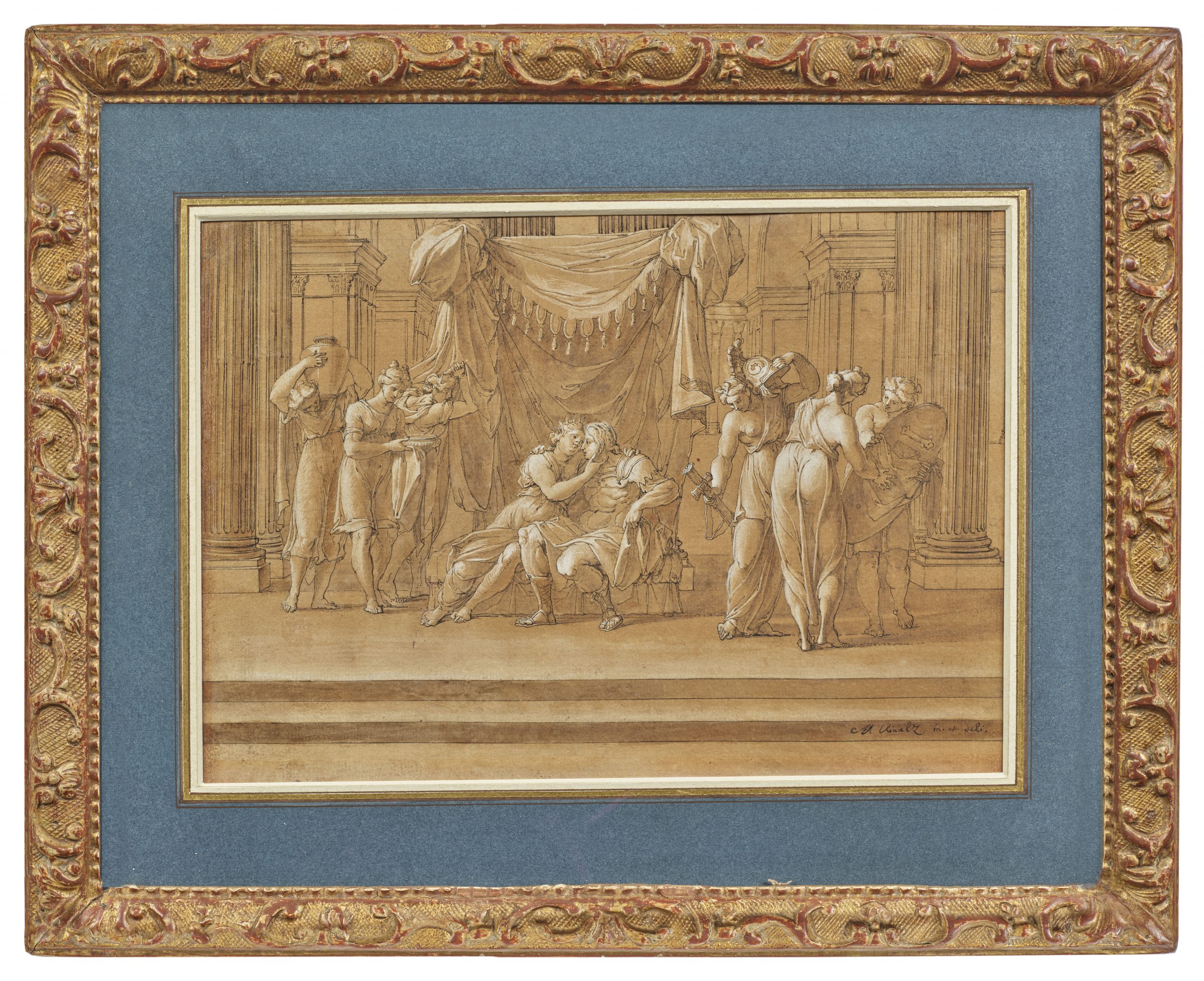
Dido and Aeneas
Pen, brown ink wash, and gouache highlights over pencil lines on paper mounted on canvas
195 x 290 mm
Signed at the lower right:
« A. Rivaltz in. et deli. »
PROVENANCE
According to a label on the reverse, formerly from the collection of the Marquis de Ferrari, Luigi Raffaele (1803–1876), Duke of Galliera; Philippe Ferrari de la Renotière (1850–1917), posthumous sale, Hôtel Drouot, June 7, 1922, no. 6.
Antoine Rivalz was born into a family immersed in the arts in Toulouse, a city where his father had been appointed architect shortly before his birth. Around 1679, at the age of twelve, the young Rivalz entered the family workshop, where he learned the foundations of his craft.
The apprentice painter then traveled to Paris, accompanying the sculptor Marc Arcis. The painter, however, remained in Paris for only a short time, as he had to return to Toulouse to assist his father in decorating the town hall. It was during this period that he began receiving his first commissions. Energized and fearless, the artist then decided to undertake a journey to Rome via the port of Marseille.
Upon arriving in Rome, Rivalz connected with the city’s most prominent artist at the time, Carlo Maratta, and his student Benedetto Luti. The Baroque style that the painter had developed in his early works gradually shifted toward the Classicism visible in our sheet, very likely dating from his Roman sojourn. The artist’s style absorbed the painting of the Bolognese school and, above all, the works of Poussin, achieving an eloquent manner that balanced the Baroque influences of his youth with Roman Classicism. The master’s influence is evident in our sheet through the clear construction of planes, the composition—both theatrical and orderly—and the meticulous drawing, effortlessly conveying both actions and volumes.
The subject is drawn from Virgil’s Aeneid, which recounts the epic journey of Aeneas across the Mediterranean after the Sack of Troy by the Greeks. The destiny of the Trojan hero, son of Anchises and Venus, was to travel to found a new city, accompanied by his son Ascanius. Before reaching the Italian coast of Latium and founding Lavinium, Aeneas stopped in Carthage and fell in love with Queen Dido, who shared his passion. This is the episode depicted by Rivalz. Usually, this scene precedes a more tragic event: Aeneas’s departure, leaving Dido, which led the unfortunate queen to take her own life.
The Murder of Priam is thus very likely the first work in a series devoted to Virgil’s Aeneid, of which our sheet is also a part, both due to the similarity in technical treatment and its subject matter. These are likely ricordi, probably intended for engraving, since another sheet depicting the same theme, this time transferred to a grid, could represent the final preparatory stage before the execution of the painting. However, to this day, no painting or print related to these sheets has been found.
Jean Penent, specialist on the artist and curator of the monographic exhibition Antoine Rivalz, the Roman of Toulouse (Musée Paul-Dupuy, Toulouse, 2004), considers the drawings of this series, monogrammed with the initials MA, to date from before 1695.