

(1763 Paris – Rome 1788)
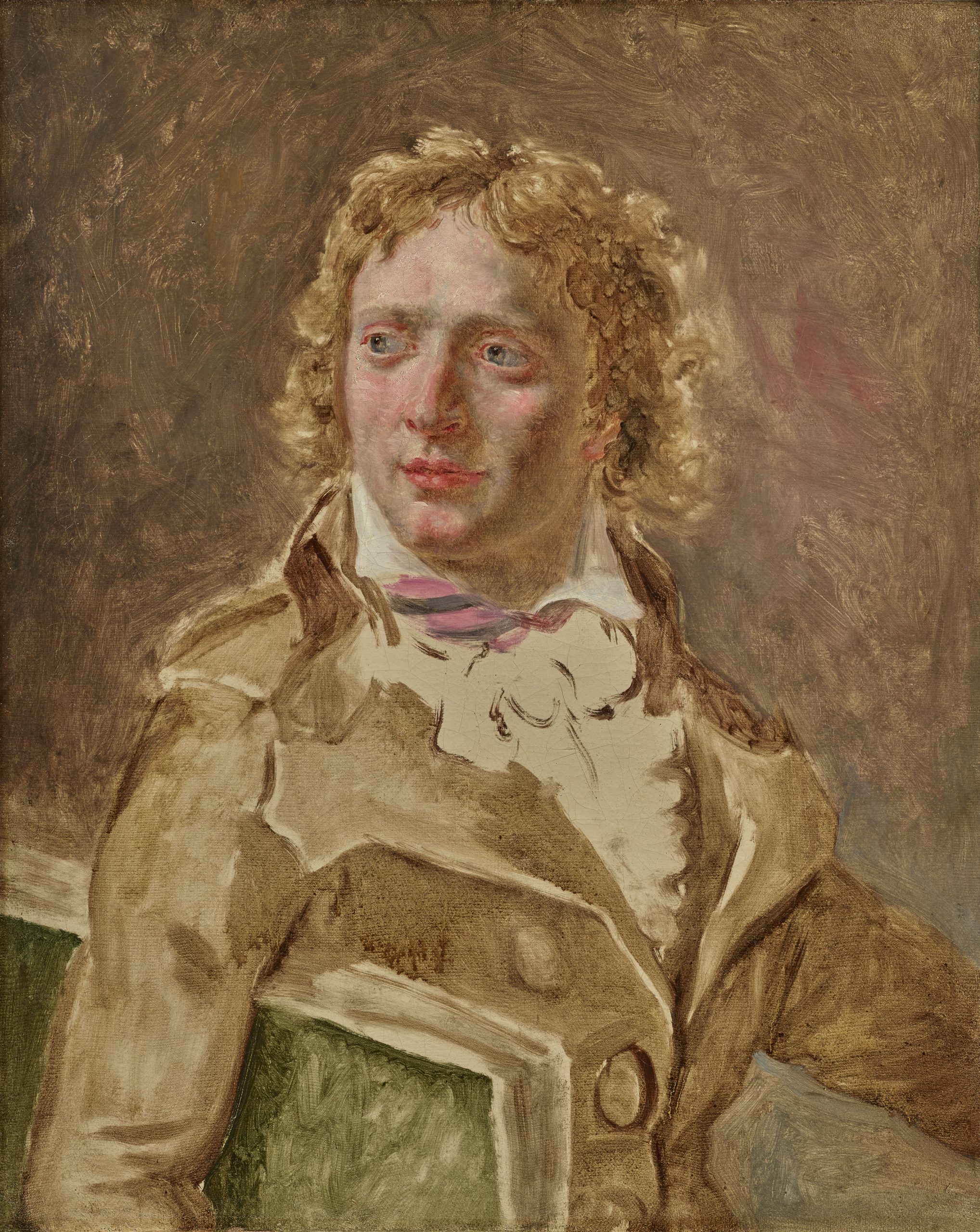
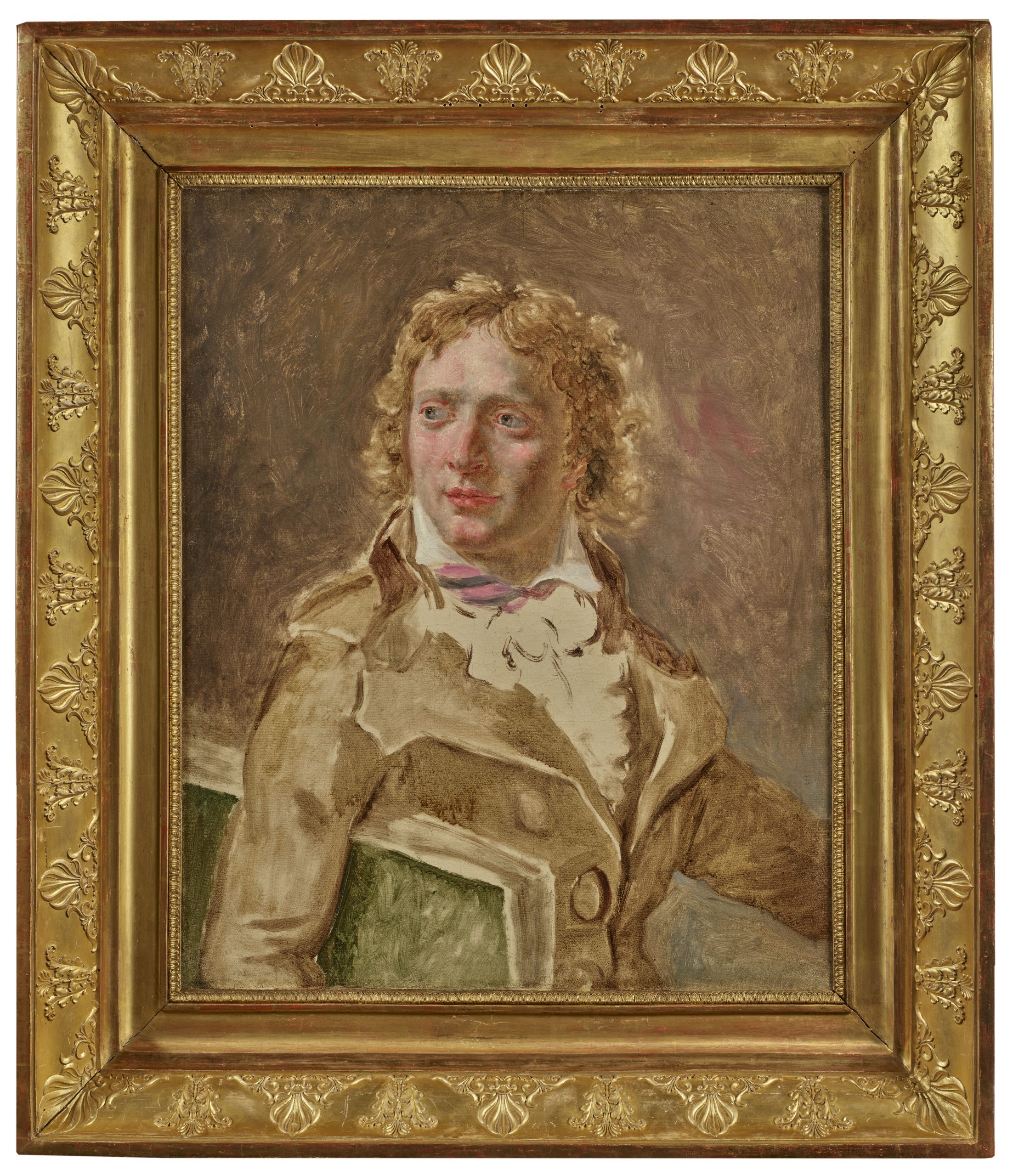
Self-portrait
Oil on canvas, unfinished
60,5 x 49,5 cm
Painted in Rome, 1787-1788
HISTORY:
Painted in Rome in late 1787 or early 1788; Madame François-Hubert Drouais, née Anne Françoise Doré (1732–1809), the artist’s mother; inherited from her sister by Marie-Jeanne Doré; inherited or acquired by one of her cousins, the sculptor Achille Valois (1785–1862); Valois family until around 1975; Heim Gallery, London; Madrid, private collection;
LITERATURE:
Juan J. Luna, « Un autoreretrato de Jean-Germain Drouais en Madrid », Archivo Espanol de Arte, t. LII, no 206, April-June 1979, p. 195-197, repr.
EXHIBITION:
Jean-Germain Drouais 1763-1788, Rennes, musée des Beaux-Arts, 7 June – 9 September 1985, P. Ramade (dir.), no 21, p. 59-60.
Rome, 1788. In the heart of the city, on the Corso, stood the French Academy, which for some fifty years had been housed in the imposing Palazzo Mancini, where each year the winners of the prestigious Prix de Rome took up residence for a period of four years. At the end of 1784 Jean-Germain Drouais arrived there, a brilliant and promising young painter from a wealthy family of renowned portraitists. He had been trained in the finest studios (Brenet, David), and his Prix de Rome had made a lasting impression: at the age of twenty, Drouais was carried in triumph by his fellow students. This victory of David’s favourite pupil was also the triumph of a circle that championed an art inspired by the ideals of classical antiquity. The master decided to undertake the journey to Rome with Drouais. It was there that David intended to paint the great picture he had in mind, The Oath of the Horatii (Louvre), destined to become the masterpiece awaited by an entire generation. Drouais contributed to the execution of the large canvas. Above all, however, he discovered Rome and immersed himself in its ancient and modern masterpieces, drawing tirelessly, to the point of exhaustion, in order to assemble the documentary material for a lifetime of artistic creation (Album Drouais, musée de Rennes).
Perpetually dissatisfied and reputedly reserved, the young pensionnaire threw himself into an ever-growing number of projects whose execution became an obsession. Four major paintings, two of them unfinished, mark the high points of the oeuvre of an artist whose career resembles that of a meteor: The Dying Athlete (Louvre), Marius at Minturnae (ibid.), Philoctetes (Musée de Chartres), and Caius Gracchus. This last composition, now lost, begun on an immense canvas (3.57 × 5.20 m) and known through an engraving and drawn studies, was abruptly interrupted by Drouais’s death (13 February 1788), when he fell victim to smallpox. The legend of a genius cut down in the prime of youth was set in motion. He was celebrated in poems (Girodet), his name was inscribed in the decoration of the new rooms of the Louvre, and the museum itself purchased Marius at Minturnae from his family in 1816 in order to exhibit it continuously.
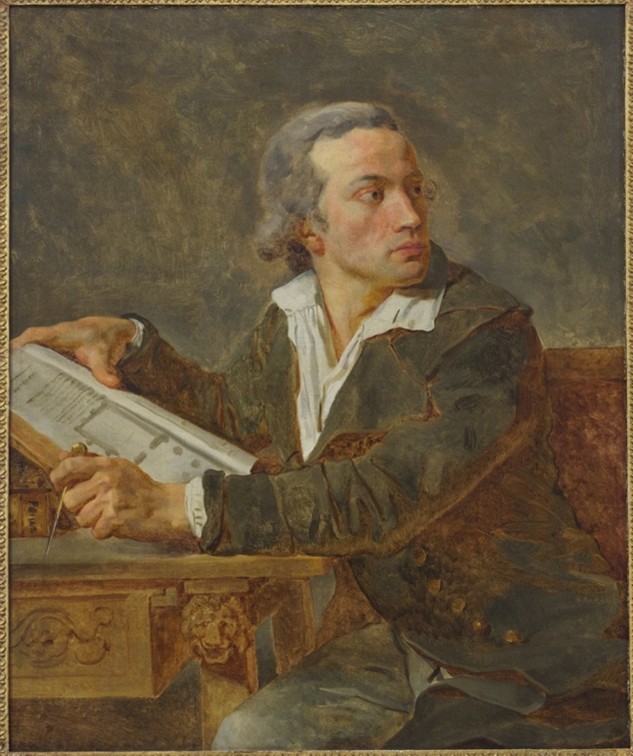
At the death of the prodigious painter, the works that remained in his studio were returned to his mother: a few canvases left in an unfinished state and a whole group of drawings. Among these canvases were two portraits: that of his closest friend at the Palazzo Mancini, the architect Auguste de Saint-Hubert, winner of the Grand Prix for Architecture in 1784, who had arrived in Rome at the same time as Drouais (fig. 1, J.-G. Drouais, Portrait of the architect Auguste de Saint-Hubert, U.S.A., private coll.). The second portrait is our self-portrait. Both were still in the state of unfinished sketches at the time of Drouais’ death. The practice of reciprocal portraits and self-portraits was very common among the pensionnaires of the Academy. In our case, Saint-Hubert was not only a close friend of Drouais but also assisted him, as an architect, in resolving questions of perspective; thus it was Saint-Hubert who set up the architectural elements in the great composition on which Drouais was working at the time of his death, Caius Gracchus (unfinished and now lost).
Drouais’s self-portrait immediately strikes the viewer with its sense of vivid, communicative life. The young painter depicts himself dressed as if about to go out, a drawing board tucked under his arm; the other arm almost raised, suggesting movement—the movement of walking—so strong is the impression that this man is about to pass before us, his gaze turned to the left, eager to set off towards a subject of study in the Eternal City or out in the open countryside. The natural and spontaneous impression is all the stronger because the movements and accents of the brush are clearly visible, charged with suggesting the volumes, forms, and movement of the fabrics. The face and hair are painted with slightly more substance, yet always with a swift and light touch. The intelligence of the gaze, the full lips, and the resolute chin convey both sensuality and an evident appetite for life. All these traits correspond to what is known of the young artist’s character: agreeable and cheerful, yet wholly devoted to what may be called a vocation—the profession of painting, to which he dedicated himself without any concession and, according to those close to him, with a certain excess. He nevertheless enjoyed going out with friends, as Gessner recalled in a letter: “We still share our studio with Drouais, a very agreeable young Frenchman and a history painter; and at our door we have Mr Denis, that skilful Flemish landscape painter. Every evening there gathers at our place almost an entire academy of truly talented artists; we laugh, we amuse ourselves, we chatter endlessly about art, and we believe ourselves to be in paradise.”
Drouais’s features are known to us through several works executed in different techniques and at various moments during his short life. The Louvre preserves a portrait of the young Drouais at the age of fifteen by Catherine Lusurier, the young artist’s own great-aunt. Drouais’s father, François-Hubert, who died in 1775, was a celebrated and much sought-after portraitist who enjoyed a distinguished career. He himself was the son of Hubert Drouais, originally from Normandy, who had been admitted to the Académie de peinture. Jean-Germain was therefore the gifted and cherished heir to a genuine dynasty of painters. Fate decided otherwise. On 6 February 1788 the director of the French Academy in Rome, Ménageot, wrote to the surintendant d’Angiviller to inform him of Drouais’s illness: smallpox, an infectious disease that would progress rapidly despite the intervention of doctors, including the Pope’s own physician, whom the director of the Academy had called upon.
He died on 13 February at the Palazzo Mancini. He was buried in the nearby church of Santa Maria in Via Lata. The death of Drouais was keenly felt, both in Rome and in Paris. David, who saw the loss of his most promising pupil, was literally devastated; he exclaimed, “I have lost my emulation.” He even went so far as to build a small monument in the garden of his lodgings at the Louvre to preserve the letters of the one he regarded as his favourite disciple.
The most touching gesture came from his fellow students at the Academy, who decided to erect, at their own expense, a monument to his memory in the form of a bas-relief stele designed by Percier and executed by the sculptor Michallon, both pensionnaires and fellow students of Drouais. This stele, still in place today, is affixed to one of the pillars of the church of Santa Maria in Via Lata. In its upper section it bears a medallion showing the profile of the young painter, executed from memory by Michallon. The director of the Academy himself specified that it was done from memory,⁷ but it may reasonably be supposed that Michallon made use of the unfinished self-portrait in order to create this moving profile.
The precious self-portrait, freshly painted, formed part of the works returned to Paris to Madame Drouais. As there were no direct heirs, these works passed to various branches of the family over the course of the nineteenth and twentieth centuries. Philoctetes (Drouais’s last major painting executed in Rome) was thus sold to the Musée de Chartres in 1885. In the early 1970s the Heim Gallery was entrusted by the Valois family, descendants of Drouais, with negotiating the sale of two portraits: that of the architect Saint-Hubert and the self-portrait. The former was acquired by a collector in the United States and the latter by a collector in Madrid, who lent it to the exhibition devoted to Drouais organised by the Musée de Rennes in 1985.
Patrick Ramade
Honorary Chief Curator of Heritage
Former Director of the Musée des Beaux-Arts, Caen