

(1901 Morschwiller-le-Bas – Gray 1973)
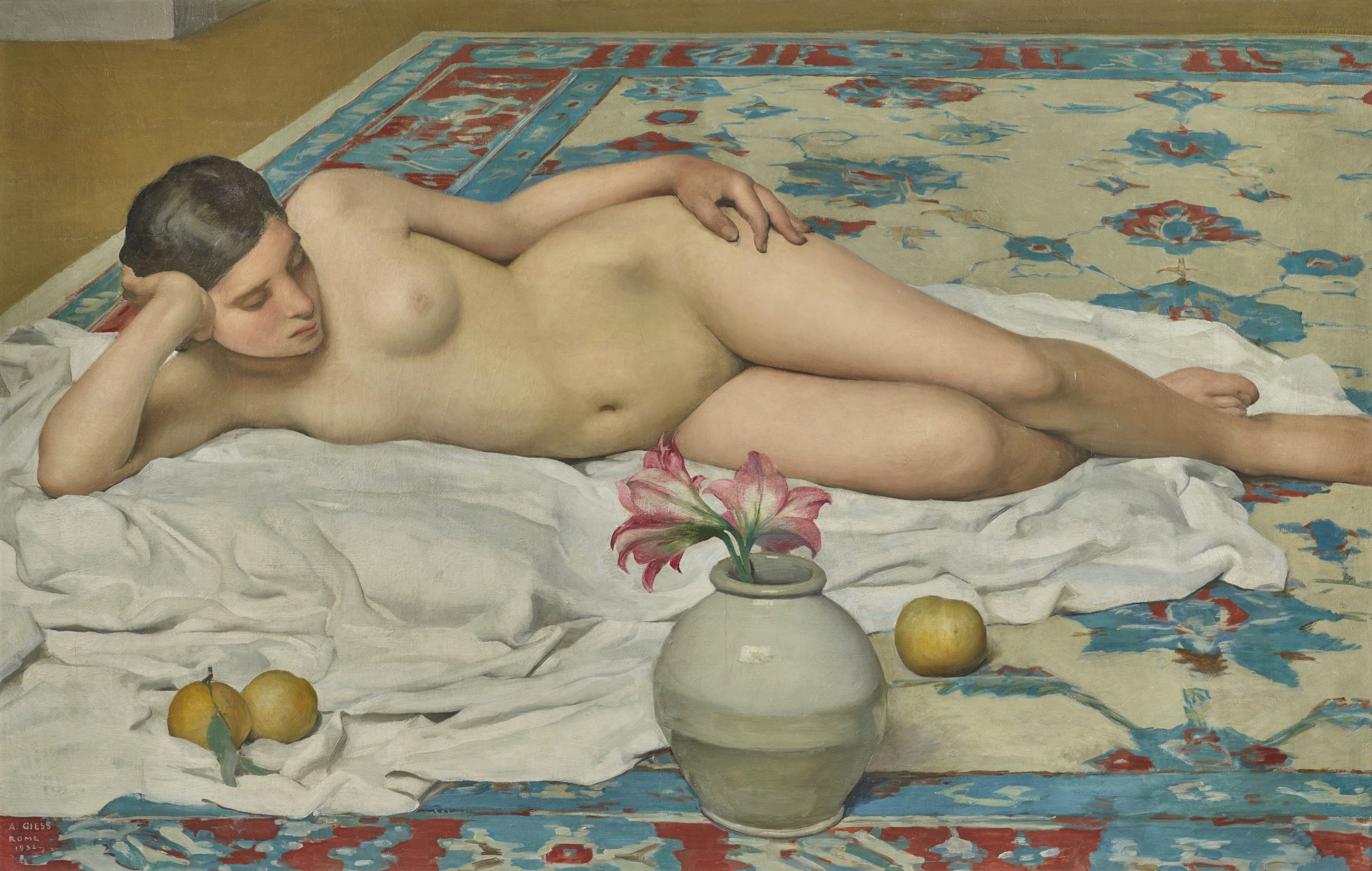
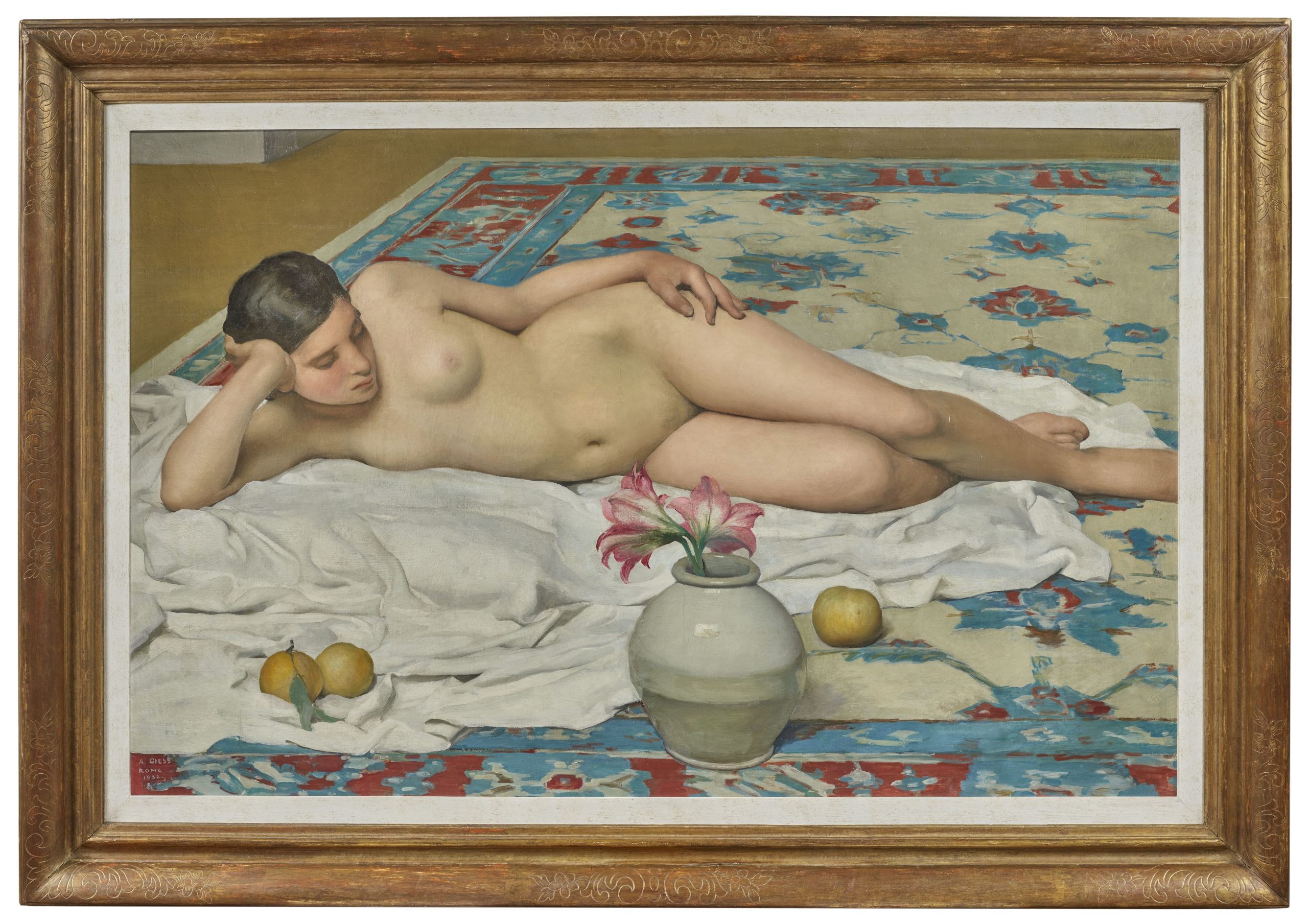
Nude on a Persian Rug with a Lily
Oil on canvas
96 x 146 cm
(Framed : 126 x 176 cm)
Signed, dated, and located lower left:
“A. GIESS ROME 1932”
Although the place and social environment in which Alfred Giess was born did not foreshadow his distinguished artistic and academic career, his father’s profession as a cabinetmaker and the industrial boom in Alsace at the beginning of the 20th century were nevertheless indicative of his artistic predispositions.
Indeed, “the child of Morschwiller-le-Bas” (Bruant, 2003) turned to textile design at an early age, a pragmatic alternative that allowed him to learn the basics of drawing in the industrial workshops of Mulhouse. This experience gave him a taste for perfection, which quickly became a source of suffering in this purely technical environment.
The upheavals of World War I interrupted his apprenticeship, but he was able to attend evening classes at the Société Industrielle de Mulhouse, which convinced him that he should persevere.
In 1921, after completing his military service in Syria, he managed to obtain a posting in Versailles, which enabled him to enroll in evening classes at the Ecole Nationale des Arts Décoratifs. Three years later, with financial support from the General Council—due to his promising talent—he managed to enter the École Nationale Supérieure des Beaux-Arts and joined the studio of Jean-Pierre Laurens (1875–1932), an academic painter whose bold yet gentle touch and sense of composition had a lasting impact on the young artist.
The artistic circle he finally managed to join reinforced his ambitions : “I felt the desire and certainty growing within me that one day I would go to Rome […] Four months later, I won first prize for landscape painting.” His determination and his brush finally enabled him to achieve his goal in 1929, with his work The Farewells, now at the École nationale supérieure des Beaux-Arts.
Giess stayed at the Villa Medici until 1933, accompanied by his entire family: his wife, Marie Huguet, whom he married in 1927, and their three children
His wife, a true muse, proved to be the painter’s greatest ally, serving as both model and agent. She is omnipresent in his work, appearing in portraits that are striking in their emotion, intimacy, and elegance. as in larger yet equally intimate compositions, such as our painting.
After staying as a resident at the Casa Velázquez in Madrid between 1934 and 1935, the painter and his family returned to Paris.
The artist’s true career then began, exhibiting at the Salon des Artistes Français until 1971, as well as in certain prestigious galleries, such as the Galerie Charpentier in 1937, which devoted an entire event to him, and the Wildenstein Gallery in New York in 1962. His works were also presented at the 1937 World’s Fair in Paris.
The painter’s recognition also extended to the institutional level, as he received numerous honors. Among other things, he directed the Jean-Jacques Henner Museum in 1957, was elected president of the Académie des Beaux-Arts in 1963, and received the prestigious medal of honor from the Salon des Artistes Français.
The loss of his wife, two years before he himself passed away in 1973, prompted him to leave Paris for the countryside of his native region, whose abundance he loved to depict.
Our large Nude on a Persian Rug with a Lily, one of his most ambitious and intimate compositions, offers the viewer a moment of fulfillment in the artist’s work and life. These years in Rome were a time of familiarity with the great masters of the Renaissance and the Baroque period, which would continually nourish his work.
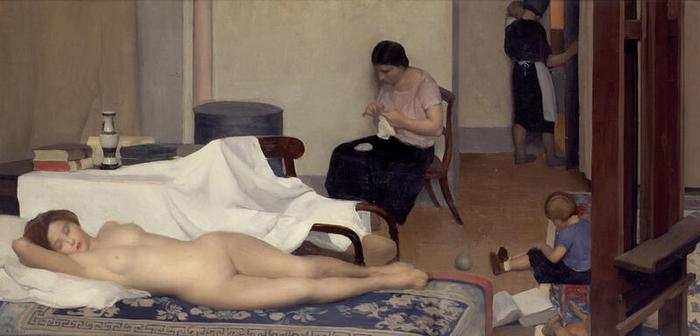
Family happiness and intimacy shine through with modesty and reserve in the paintings depicting the Roman interior he occupied at the Villa Medici. He reveals his children and Marie, his wife and revered model, through scenes whose apparent torpor is matched only by their tenderness (fig. 1, Alfred Giess, My Roman Studio, 1932, oil on canvas, Roubaix, La Piscine, Musée d’Art et d’Industrie). It is interesting to note that the Persian rug on the right of the previous composition is the same as the one on which the model is reclining in our painting.
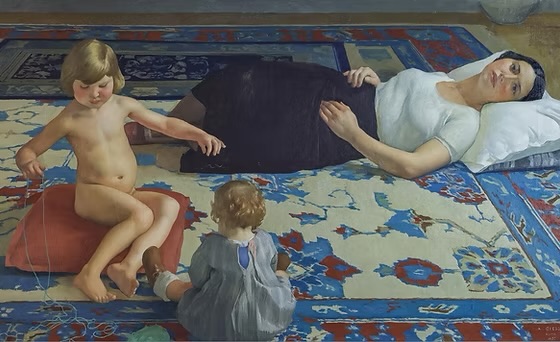
Another majestic painting, in which the artist overlooks his model, lying next to her children, pensive and contemplative on the same Persian rug with floral and geometric patterns, is part of this series of perfectly composed paintings, in which Giess establishes a bridge between the modernity of the triumphant Art Deco of the 1930s and the lessons of the masters of the past, from Titian’s Venus of Urbino to Zurbaran’s virtuoso and resplendent whites (fig. 2, Alfred Giess, Studio Scene, 1933, oil on canvas, private collection).
Unlike the paintings in the series mentioned above, our work focuses the painter’s entire attention on his muse. Marie appears as a modest Venus, meditating with half-closed eyes on the symbolic objects arranged on the carpet before her, the only motifs between the viewer’s gaze and the model’s nudity: the fruits of temptation and the lily of purity, discreet evocations of Eve and the Virgin Mary.
Whether through his brushwork, his framing and composition, or the symbolism he instills in his works, Giess always manages to create a magnetic tension between his figures and the viewer.