

T-GIRODET
(Montargis, 1767 – Paris, 1824)
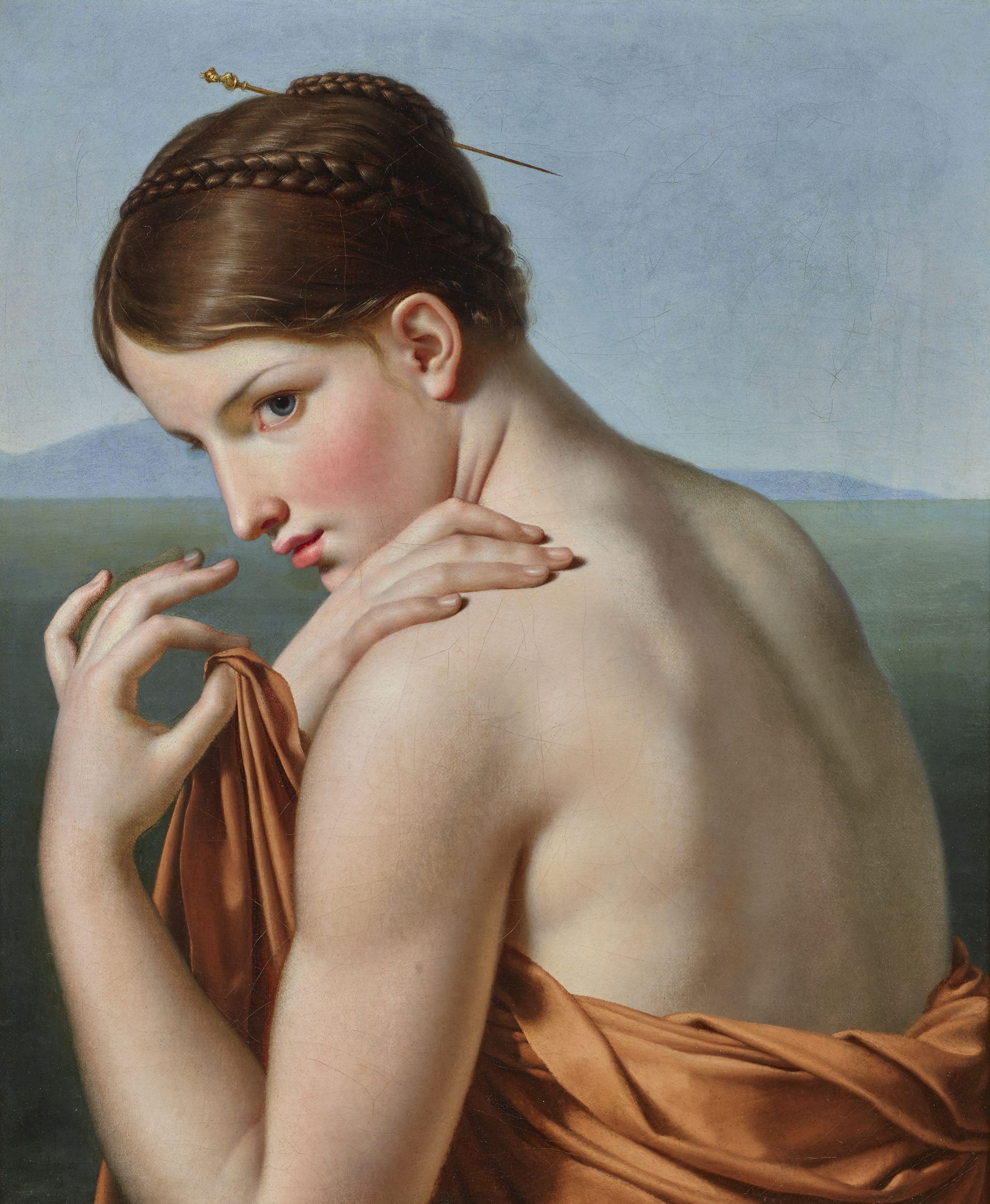
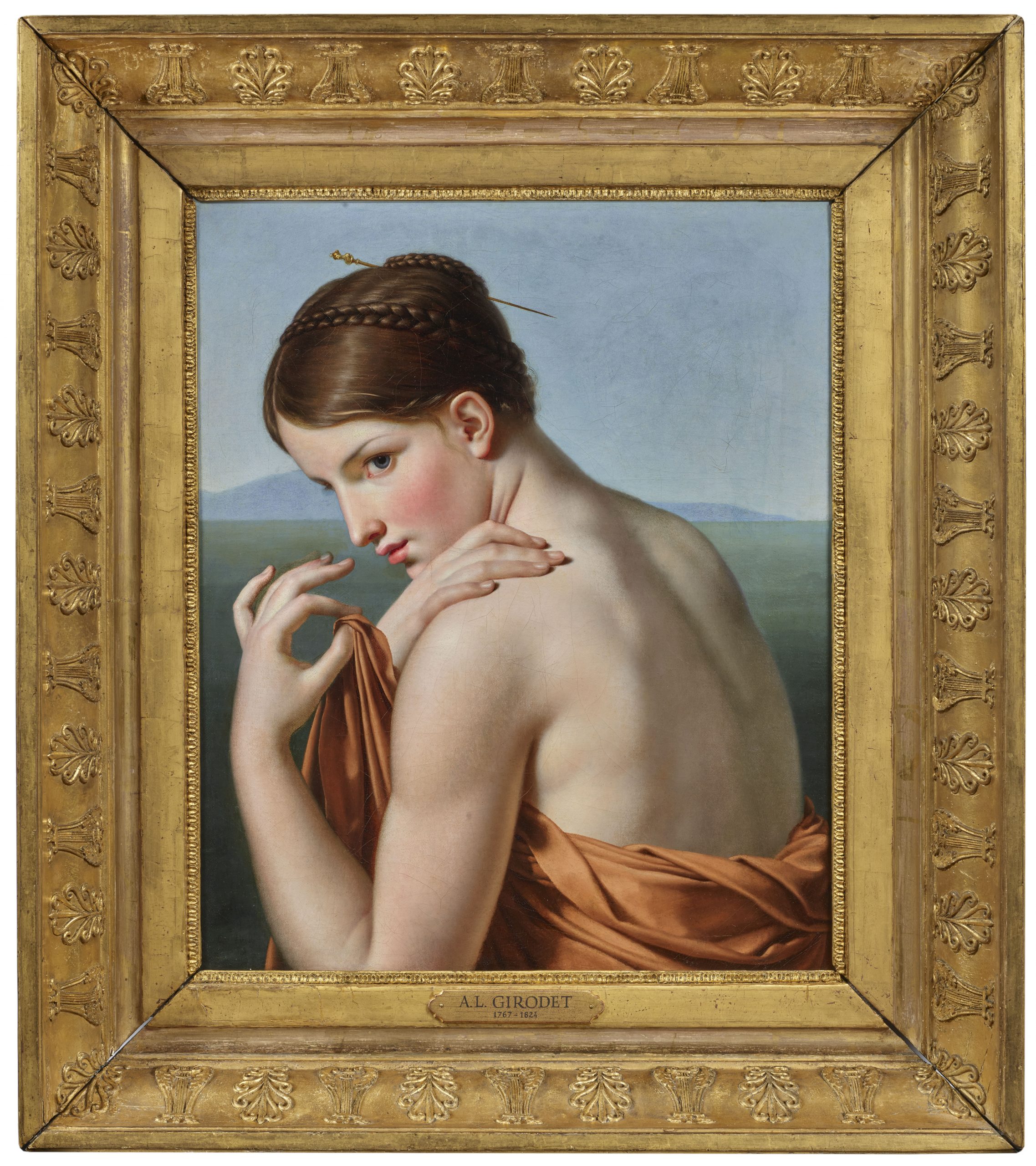
Young Nymph Bathing
Oil on canvas
56 x 46 cm
Monogrammed lower left with the intertwined letters “G.A.L.”
Provenance:
Collection of Marie-Françoise Robert Bazin (1774-1862) and Fanny Robert (1795-1872) ;
Collection of Caroline Robert, daughter of Marie-Françoise, born in 1796, who married Louis Rossigneux (1786-1864) in 1813 ;
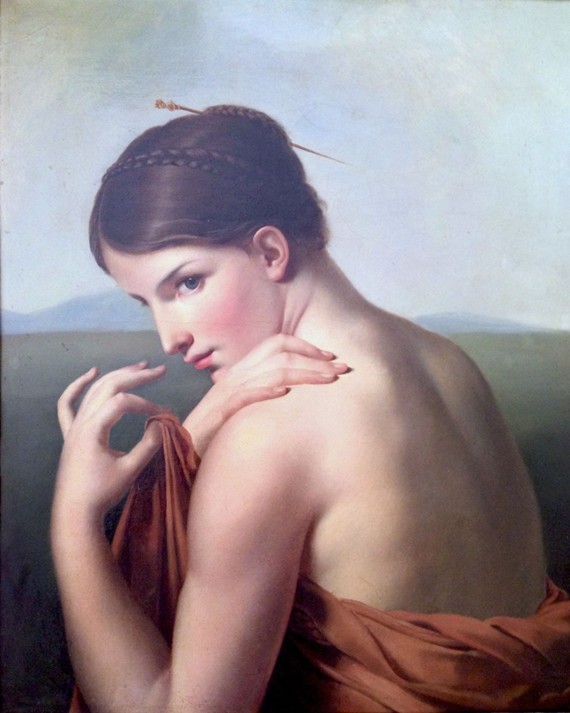
Collection of Charles Rossigneux (1818-1907) (opposite: photograph of the painting hanging in his home), architect and interior designer, son of Caroline Robert and Louis Rossigneux, then his descendants;
Collection of Raymond Fischof-La Foux (1905-1980) and Suzanne Fischof-La Foux née Auclert (1920-2023);
Raymond & Suzanne Fischofi-La Foux Collections – Part I: An apartment on Avenue Foch, Osenat, February 21, 2024, lot 228 (as “French school circa 1800, studio of Anne-Louis Girodet”).
Exhibition:
« Gros & Girodet, Chemins croisés » Girodet Museum (December 11, 2024 – March 16, 2025) curated by Sidonie Lemeux-Fraitot and Valérie Bajou.
Literature:
Explanations of the paintings exhibited for the benefit of the Greeks, Galerie Lebrun (rue du Gros- Chenet, no. 4), Paris, 1826, p. 22, no. 80 ;
Pierre-Alexandre Coupin, Œuvres posthumes de Girodet-Trioson, peintre d’histoire, volume I, Paris, 1829, p. LXV ;
Gros et Girodet, chemins croisés, exhibition catalog, May 2025, cat. n°8, p.246 and ill.p.217.
Related works:
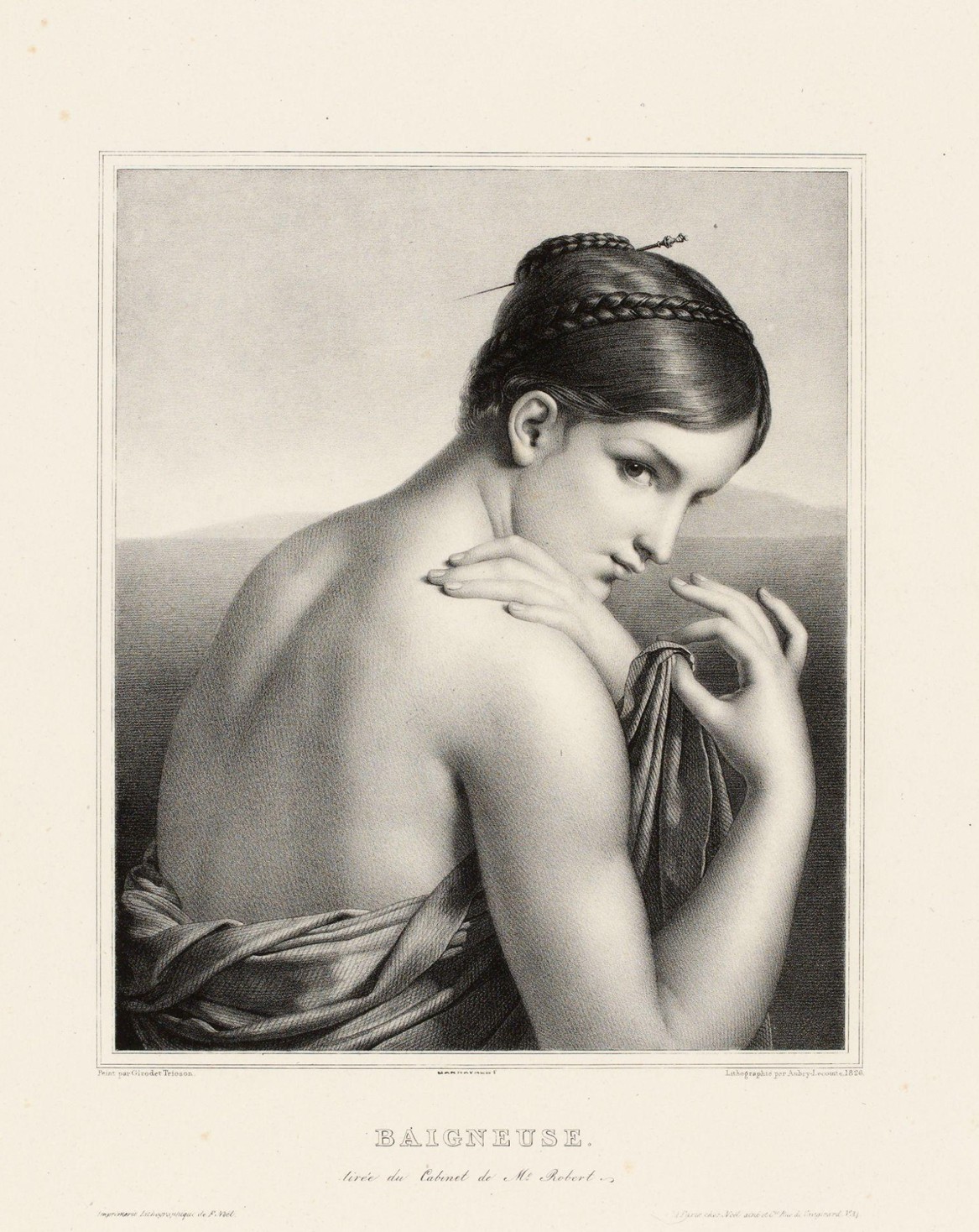
Jean-Baptiste Aubry-Lecomte after Girodet, Baigneuse Taken from the collection of Madame Robert, lithograph, 1826, Musée Carnavalet, Paris.
Anne-Louis Girodet-Trioson, A Young Nymph Bathing, half-length study, oil on wood, location unknown, 60 x 49.5 cm (Salon of 1799, no. 149).
At the Salon of 1799, Anne-Louis Girodet, then at the height of his career and finally freed from the authority of his master Jacques-Louis David, presented two paintings. The first, a portrait of Madame Simon, was only exhibited for two days, as the model demanded its removal as soon as the exhibition opened. The affair caused a scandal that was widely reported in the press. The second, a half-length study of a young nymph bathing, was a resounding success.
Our painting depicts this same young nymph bathing, resembling a Venus full of grace and sensuality. The composition, combined with a fine and delicate technique, muted colors, and a tight, almost photographic framing that accentuates the effect of a fleeting glimpse of beauty, makes this work a perfect example of Girodet’s aesthetic and artistry at the turn of the century.
Our work could be the first idea for the Salon painting (fig. 2), as there are clearly visible changes, particularly in the young woman’s fingers. These changes could be explained as a search for the positioning of the fingers, a form of hesitation that could thus confirm that our work is the first version.
However, it could also be a replica made by Girodet. The work exhibited at the Salon was so successful that this other version, of brilliant quality, could be interpreted as having been commissioned from the artist by one of his patrons.
Indeed, our painting was part of the prestigious collection of Marie-Françoise Robert Bazin (1774–1862), a patron close to the artist. Girodet frequented her salon from 1807 onwards, in the company of other artists and men of letters, such as Chateaubriand. In 1817, Madame Robert asked the artist to take her two deaf-mute children, Fanny and Édouard, into his studio. She encouraged the creation of a women’s studio where Girodet could provide artistic education to young girls. The deep friendship between the artist, Marie-Françoise, and her daughter Fanny is also attested to by a rich exchange of letters.
Upon Girodet’s death, his student Jean-Baptiste Aubry-Lecomte translated several of the master’s masterpieces into engravings. This pioneer of lithography called upon Fanny Robert to gain access to the iconic painting of the Young Nymph. The latter, our painting, was thus faithfully reproduced in engraving.
Unlike the Salon painting, the framing is tighter and among the many small details we notice the presence of a strand of hair near the left ear and other details that are completely absent from the Salon work. Thanks to this engraving (fig. 1), the strong and mischievous gaze of the beautiful young woman was immortalized in a series of black and white prints, testifying for posterity to the artist’s spirit and powerful talent.
We would like to thank Sidonie Lemeux-Fraitot for confirming the authenticity of our work, created by Anne-Louis Girodet-Trioson around 1799-1800, for indicating that it was an autograph replica of the Salon painting, and for specifying that our painting, from which several copies were made, is indeed the one engraved by Aubry-Lecomte in 1826. We also thank her for providing us with the photograph of our painting in Mr. Rossigneux’s home.