

(1795 Mechelen – Venice 1872)
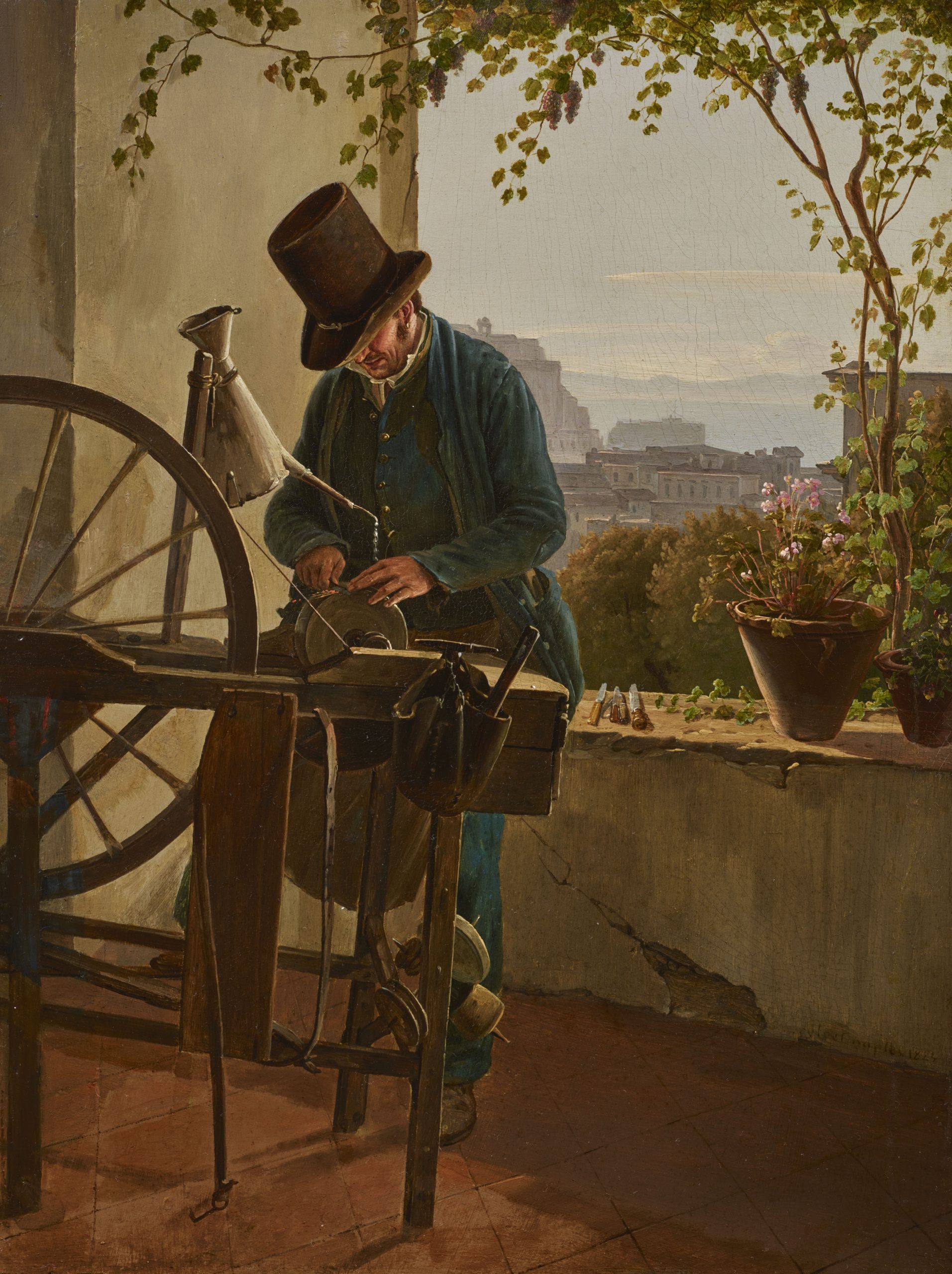
The Knife-grinder
Oil on panel
32,2 x 24,5 cm
Signed, dated and located lower right : “Vervloet naples 1824“
A native of Mechelen, Vervloet began, at a very early age, to attend the lessons of Jacques de Raedt at the academy of his native city, where he quickly distinguished himself through his talent and precocity. After exhibiting a series of watercolours depicting the Battle of Waterloo, he was appointed professor and, in 1821, was awarded the Prix de Rome of the Royal Academy of Amsterdam.
The following year he set out for Italy and lived first in Rome, thenin Naples, in Sicily, and finally in Venice, where he died in 1872.
As early as 1824, his Interior of St Peter’s, Rome earned him the praise of the painter Léopold Robert, a canvas deeply inspired by the art of Granet, whom he frequented at that time.
After two years spent in Rome, he settled in Naples, the metropolis of southern Italy and a European capital of tourism, which attracted wealthy travellers and their purveyors of souvenirs: the painters of vedute. Together with Anton Sminck van Pitloo and Giacinto Gigante, Vervloet was one of the leading figures of the School of Posillipo — named after one of the hills of Naples — bringing together these view painters whose works depicted picturesque scenes bathed in Mediterranean light.
Our Neapolitan panel fits squarely within Vervloet’s production as a painter of vedute. As is often the case with the artist, the framing is original, almost photographic, guiding the eye towards a sumptuous view in the background.
This view unfolds through vine branches that frame the space of a terrace and its parapet. The dense, bluish atmosphere created by the artist conveys the heaviness of the air and the feverish heat that reigns in the streets of Naples.
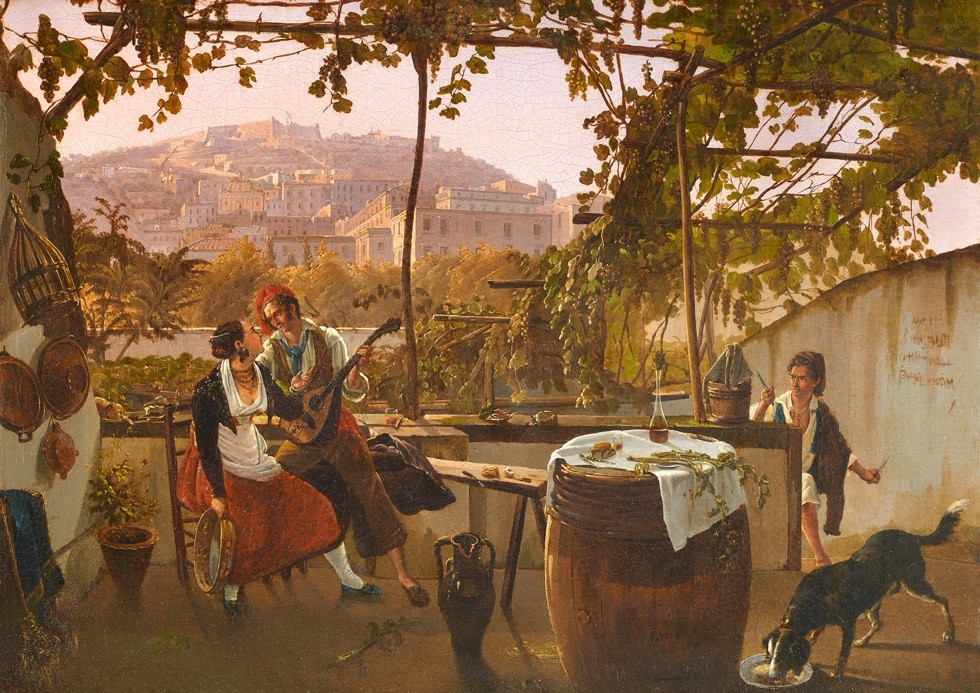
The buildings are difficult to identify with certainty, yet it is possible to approximate the painter’s position. The rise on the left, surmounted by a kind of lantern, may correspond to Monte Echia, the rocky hill at the heart of the San Ferdinando district. Further towards the centre of the view, in the distance, one recognises the dark, quadrangular mass of the Castel dell’Ovo, whose summit adorned with a cross is just faintly visible both in our work and in Pitloo’s painting mentioned earlier. Finally, the opening of the bay towards the right and the absence of the shadow of Vesuvius (to the right) suggest that Vervloet chose to set up his easel on the slopes of the Vomero hill, which he depicted in a similar work — this time seen from below (fig. 1, Frans Vervloet, Serenade on a Terrace, Naples, oil on canvas, 1830–1835, Galerie Didier Aaron & Cie.).
Beyond this delightful veduta, the principal subject of our panel is a knife-grinder at work. This trade is described by Pierre Jaubert in his Dictionnaire raisonné universel des arts et des métiers of 1771 under the evocative term Gagne-Petit (‘Jack-of-all-trades’ or literally ‘earn-a-little’): “He is a journeyman cutler who pushes before him, or carries upon his back, a small workshop fitted with a grindstone, a hammer, and a whetstone, in order to sharpen and repair various small articles of cutlery. To distinguish themselves from cutlers, who are also grinders, they call themselves among one another rémouleurs à petite planchette, on account of the small plank beneath their foot, by the movement of which they set their grindstone in motion.” The plates of the Encyclopédie by Diderot and d’Alembert further enrich this vocabulary concerning the highly specific tools of the knife-grinder.
As indicated in the definition, our knife-grinder operates the ‘small plank’ with his foot, enabling the grindstone — by means of a wheel and a system of rope and pulley — to turn rapidly enough to sharpen the blade. A device positioned above the stone allows water to trickle down from a watering-can-shaped container in order to moisten the grinding surface. Several blades and files rest upon the parapet beside a flowerpot; the hammer used for straightening is placed in the satchel, while polishing tools hang from the lower part of the barrow.
A pentimento by the artist on the left suggests that a second, smaller figure was originally present; only traces of a hand and a red-striped-on-navy-blue motif remain. Perhaps this was the knife-grinder’s child, assisting his father in his labour? Be that as it may, the central figure, absorbed in his task, is rendered with meticulous brushwork. The density of the paint conveys the varied textures — stone, metal, wood, leather and the fabrics composing the knife-grinder’s attire.