

(1756 Azay-le-Ferron – Versailles 1827)
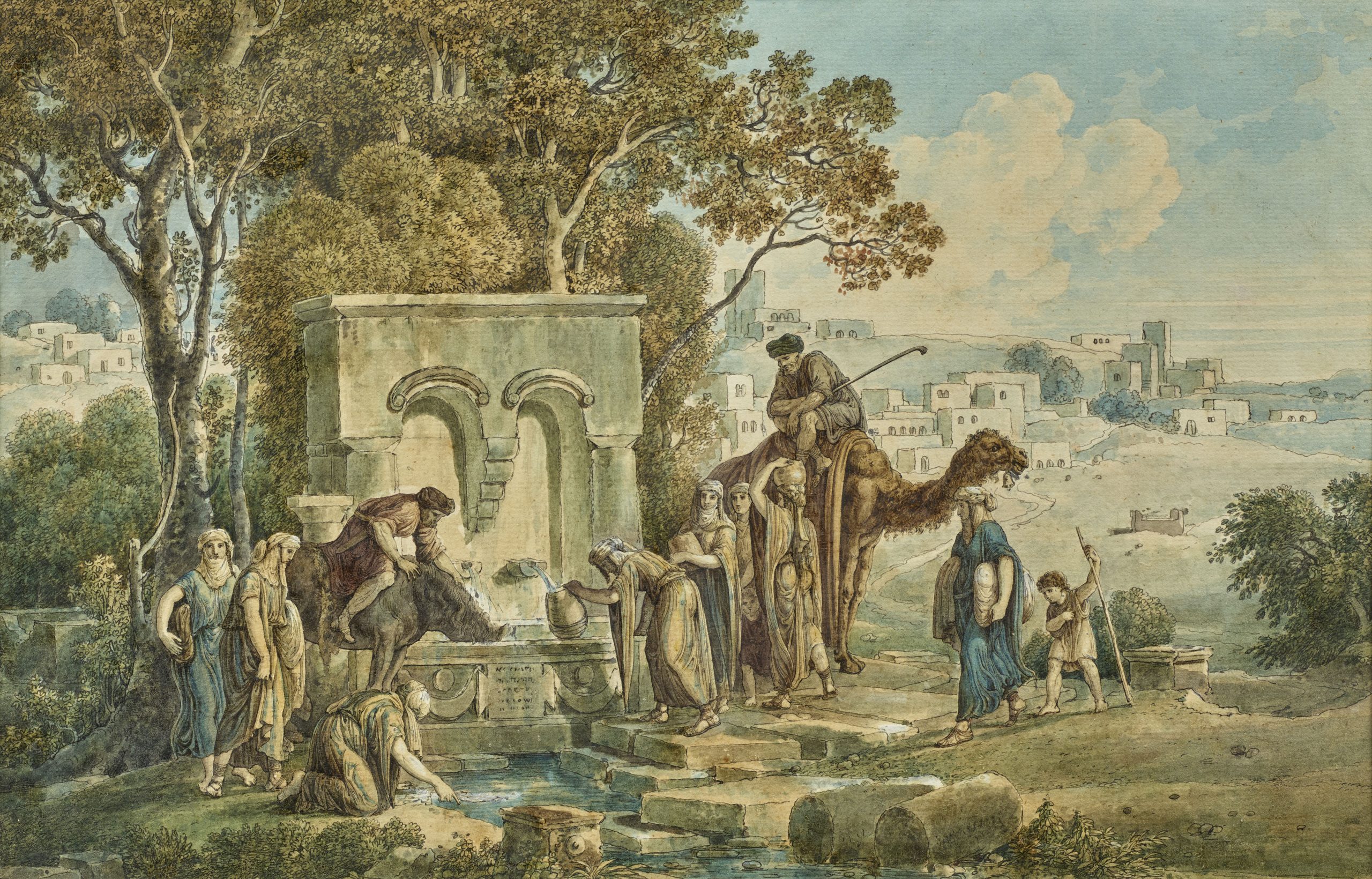
Vue de la fontaine de Cana en Galilée
Pen, watercolour, and gouache on paper
220 x 341 mm
Circa 1785-1790
RELATED WORKS
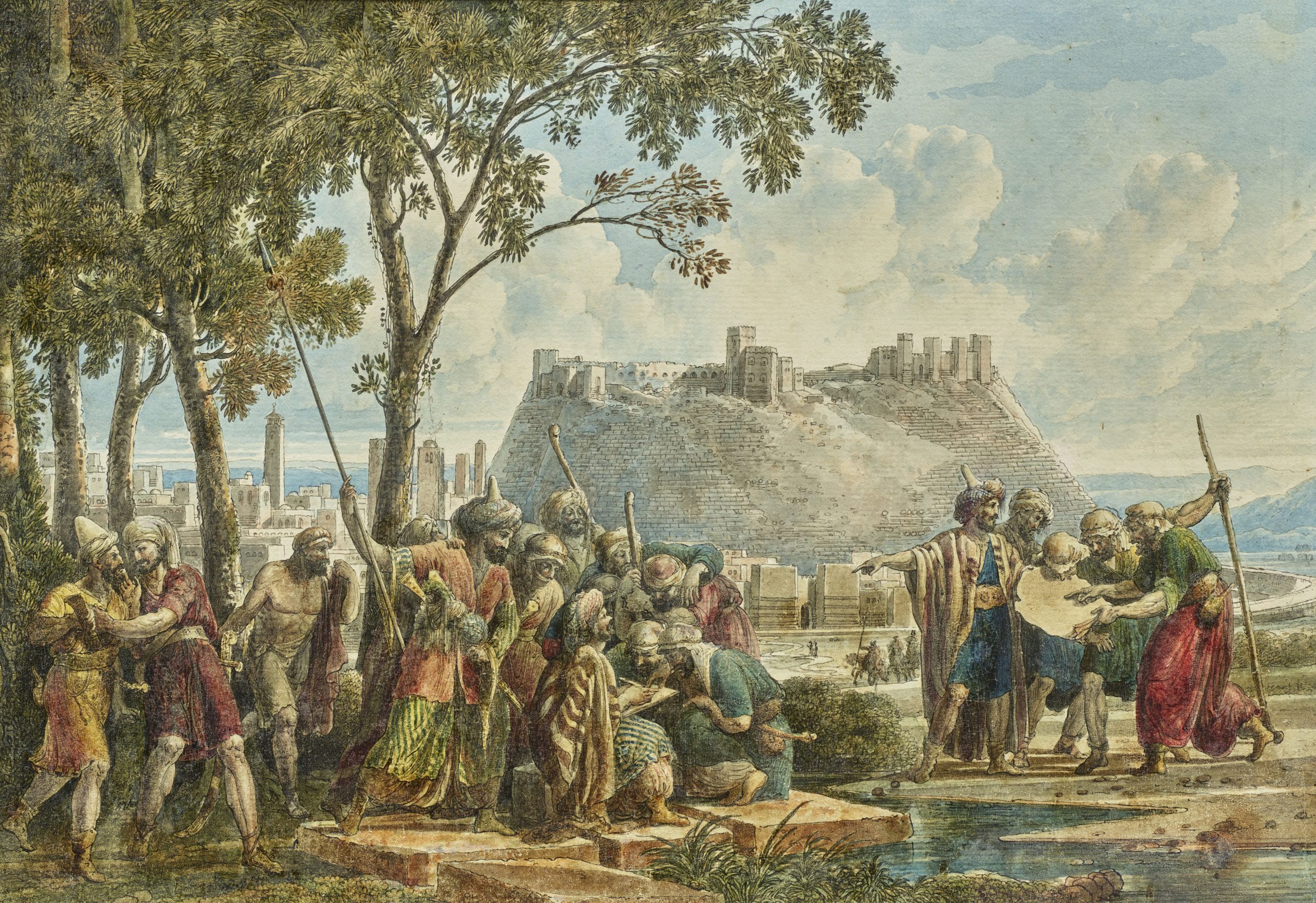
Louis-François Cassas, View of the Citadel of Homs, watercolour and gouache, c. 1785-1790, Galerie Didier Aaron & Cie (fig. 1).
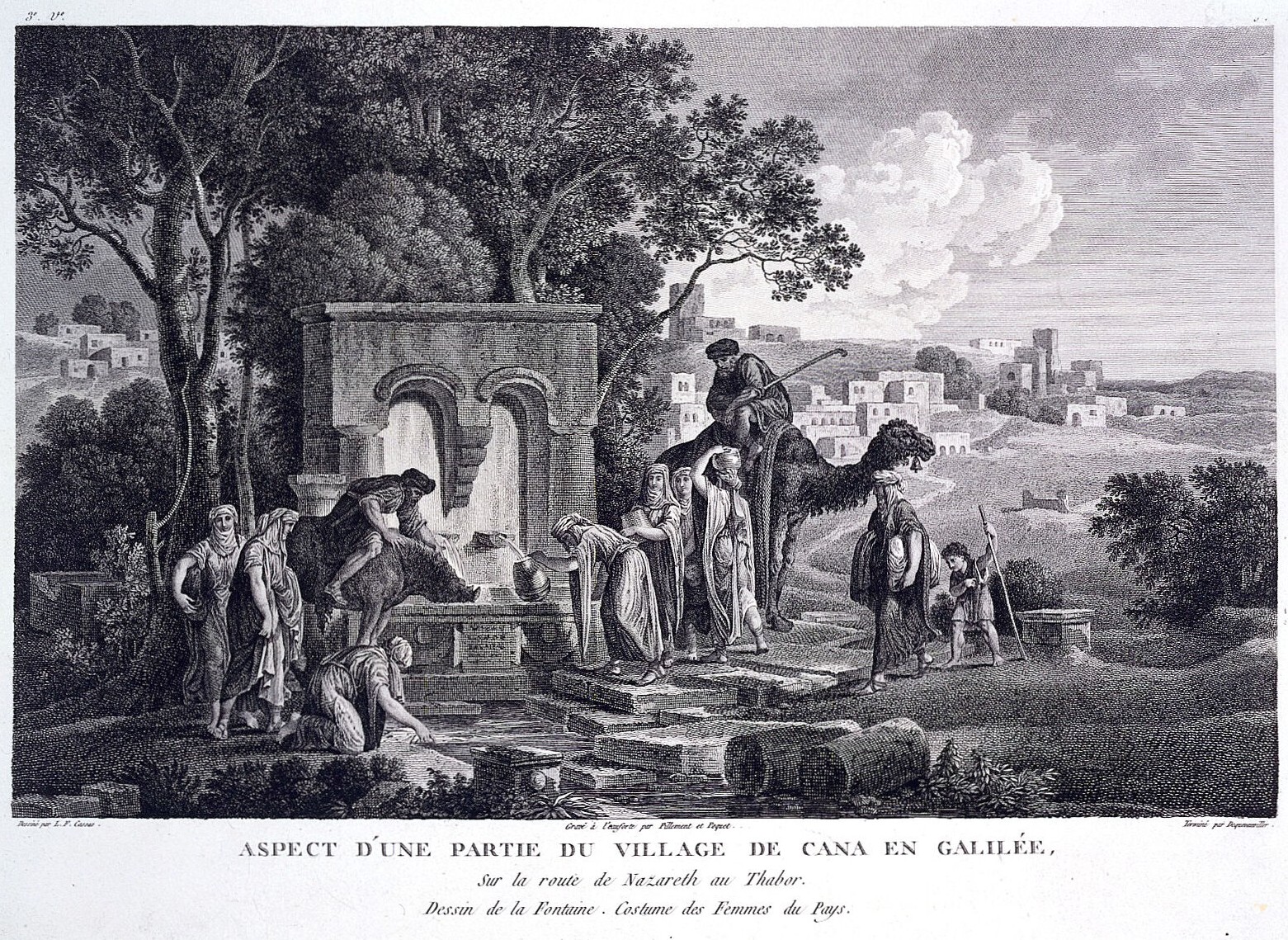
Jean Pillement, Jean Louis Charles Pauquet and François Dequevauviller after Louis-François Cassas, Aspect d’une partie du village de Cana, en Galilée, etching, in : Louis-François Cassas, Voyage pittoresque de la Syrie, de la Phénicie, de la Palestine et de la Basse-Egypte, vol. III, pl. 3, Paris, 1798 (fig. 2).
Cassas (here portrayed by Dominique Vivant Denon, 1786, Louvre Museum, detail) spent his early formative years in the Parisian residence of the Duke of Rohan-Chabot, where a drawing school had been established. Although the lessons of Vernet, Vien, Lagrenée, and Leprince were valuable to him, it was his stay in Italy from 1779 to 1783 that had the greatest influence on his career. In Rome and Campania, Cassas developed a growing interest in ancient sites and monuments. His talent for drawing was exceptional, and he worked tirelessly, traveling throughout Italy, Greece, and Dalmatia. A little later, he accompanied the Count of Choiseul-Gouffier to Constantinople, and for four years traveled across the Near East and Asia Minor, recording all the classical sites. At the beginning of the 19th century, he used his drawings to produce books about his travels. His career remains closely linked to the rediscovery of ancient civilizations, and his drawings, books, and engravings are also unique testimonies to this period.
In 1784, while he was in Constantinople with Choiseul-Gouffier, Cassas decided to set out for Syria and Egypt to gather a substantial collection of drawings in preparation for the publication of his Voyage Pittoresque, which was to appear in Year VI (1798). After only a few days on this new journey, and following a storm, Cassas’s ship—a corvette named Poulette—was forced to stop at Smyrna, where the artist received such a warm welcome that he stayed for nearly a month, including eight days in Ephesus drawing and measuring all the remains of the Temple of Artemis and the Gate of Persecution. It was while he was in Tripoli that Cassas decided to cross the Syrian desert to discover the famous ruins of Palmyra. An intrepid traveler, he equipped himself with special letters of recommendation from M. de Voize and the necessary gifts for the sheikhs. Dressed in oriental costume, wearing a beard, and, as was appropriate, well armed, Cassas joined a caravan in May 1785 in order to finally reach Palmyra. Numerous twists and turns punctuated his journey, sometimes in unfortunate ways, as when he was attacked by brigands.
However, the artist’s unwavering determination and courage enabled him to produce more than a hundred drawings from the site of Palmyra alone. He then decided to travel to the temple at Baalbek, farther south, and went as far as Bsharri in the mountains of Lebanon.
Cassas was forced to remain immobile for nearly two months, hidden in the hollow of a rock with Maronite monks—Syrian Christians—due to the spread of the plague in Syria. This episode encouraged him to continue his journey southward, bringing him to Palestine, to Galilee, and in particular to the village of Cana, whose picturesque life is depicted in our watercolour.
The foreground is occupied by a small stream fed by the spring of the fountain, where the figures gather peacefully. A few trees adorn the stones of the building, set upon ground strewn with archaeological fragments. In the background, a lightly washed blue sky bathes the dwellings of the village of Cana in gentle light, situated just west of the Sea of Galilee.
The composition chosen by Cassas is quite similar to his View of the Citadel of Homs (fig. 1), mentioned among the “related works.” Both of these works are original watercolours and preparatory studies for etchings in the Voyage pittoresque de la Syrie, de la Phénicie, de la Palestine et de la Basse-Égypte, a remarkable collection of 330 plates, all engraved from drawings under Cassas’s direction.
One may read in a prospectus printed in Year VI at the expense of the Republic: “Supporting the efforts of the author and wishing to uphold, together with him, the agreements successively made with the enthusiasts mentioned above, (the government) has undertaken to cover all the expenses required for the finest execution of the engravings of this work (…) already more than one hundred plates have been completed and two hundred others have been prepared in etching by the most skilled engravers, all of whom have been and continue to be employed on this enterprise…”
A note further confirms that “the government, convinced of the usefulness of this undertaking for the progress of the arts and of its close connection with the teaching of architecture and the interests of commerce, supported it with perseverance even amid the crises of the Revolution, by ordering at its own expense the engraving of the plates and the printing of the text.” The preparation of this text had been entrusted to the “citizens” Ginguené, a member of the Institut, for the historical section and the writing of the travel account; Legrand, architect, for the theoretical and descriptive aspects of architecture; and Langlès, also a member of the Institut, for the section on Oriental languages and inscriptions. Beginning in 1798, the work was published in monthly installments, each consisting of ten plates accompanied by their explanations.