

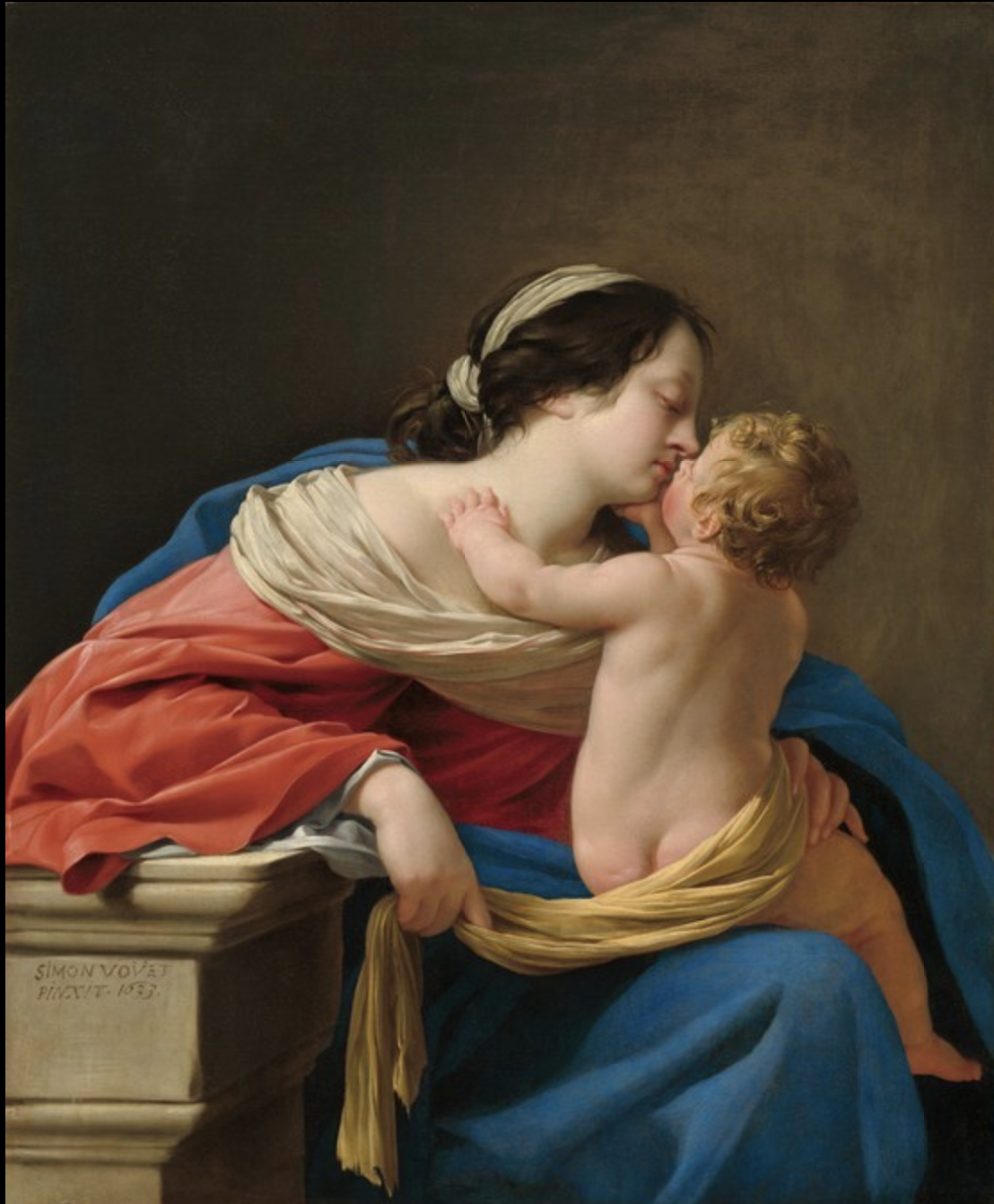
SIMON VOUET
(1590 – Paris – 1649)
Madonna and Child
Oil on canvas
110.3 x 89.4 cm.
137.8 x 118.43 cm framed.
Lower left on the stylobate, with an umlaut above the V and a dot above each I: SIMON VOVET / PINXIT.1633.
National Gallery of Art.
Origin:
Listed 1644 in the will of Claude Bordier [d. 1644], wife of Etienne Lybault [d. 1641], to be given to the first of her four daughters who decided to become a nun, as payment to the convent she entered.[1] Acquired 1840 in Genoa by Eugène-Alexandre de Montmorency [1773-1851], 4th Duke of Laval, Borgo Cornalese, near Turin;[2] by inheritance to his second wife’s brother, Rodolphe de Maistre [1789-1866], Borgo Cornalese; by inheritance to his son, Eugène de Maistre [1834-1908], Borgo Cornalese;[3] by descent in the De Maistre family; purchased 2014 by (Didier Aaron, Inc., Paris, London, and New York); purchased May 26, 2016 by NGA.
[1] See: Françoise de la Moureyre, “The artistic taste of a great financier in the 17th century: Jacques Bordier,” La Tribune de l’Art (June 2013): on-line at www.latribunedelart.com. This article was kindly brought to the Gallery’s attention by Elodie Vaysse; see her e-mail of 12 April 2016 to Mary Morton, in NGA curatorial files. The painting was listed in Bordier’s inventory at her death in 1644, and was presumably kept by the family for one of her daughters. Both the will, dated 23 January 1644, and the inventory, dated 11 March 1644, are in the Central Minutes of the Notaries of Paris (Minutier central des notaires parisiens), National Archives, Paris.
[2] The duke perhaps acquired the painting to decorate the altar of a private church he commissioned in 1850 for his villa near Turin. He had no children with either of his two wives, Maximilienne de Béthune-Sully (1772-1833) and Anne Constance de Maistre (1793-1882), and the villa and its contents passed to his second wife’s brother. The Duke’s second wife remained in residence at the villa until her death. Her brother, Rodolphe de Maistre, also inherited from his brother-in-law the Château de Beaumesnil in northern France.
[3] One of eleven children, Eugène inherited his uncle’s villa, and with his wife and their nine children constituted the branch of the Maistre family in Borgo Cornalese.