

(1756 Azay-le-Ferron – Versailles 1827)
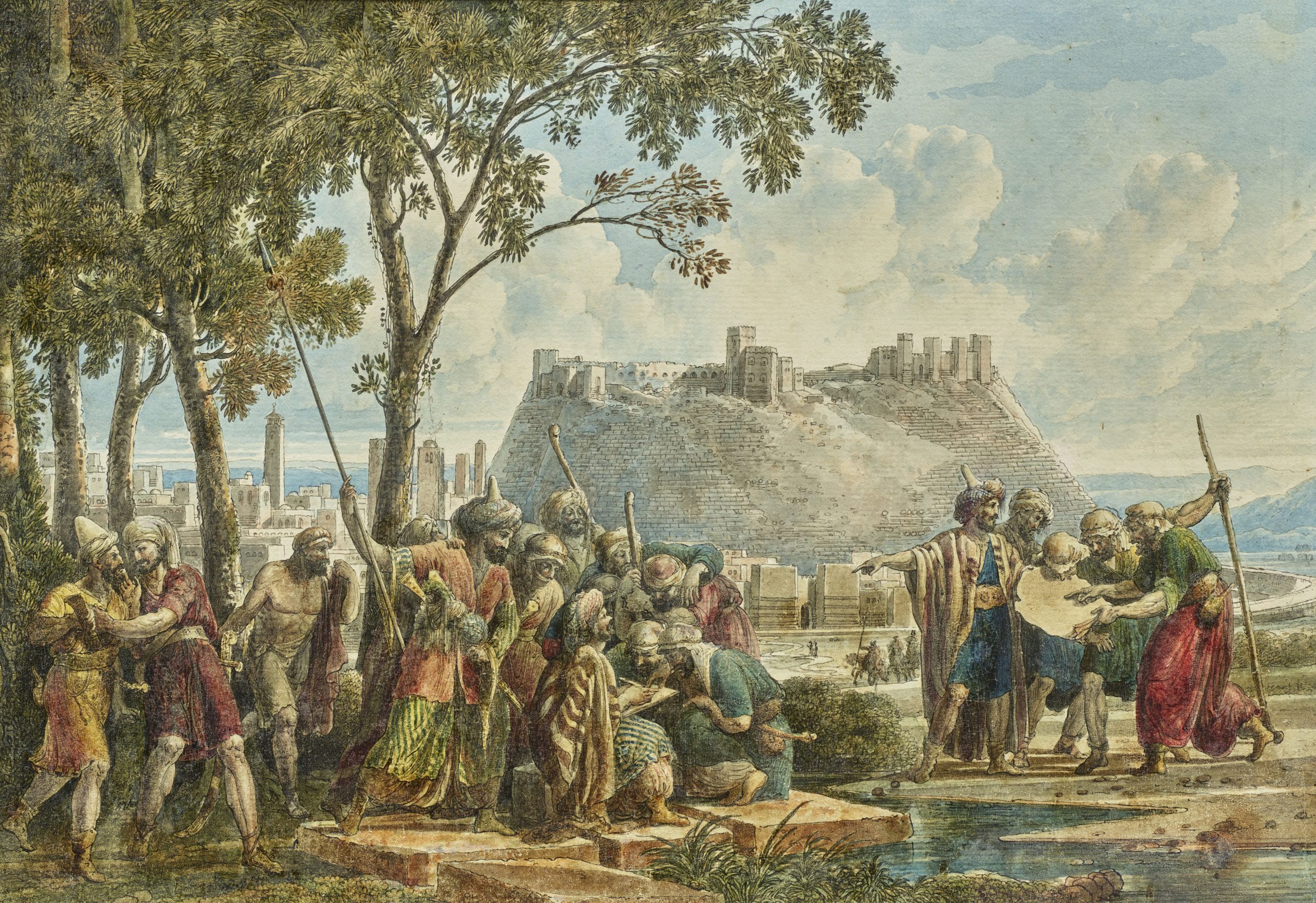
View of the Citadel of Homs
Pen, watercolour, and gouache on paper
238 x 364 mm
Circa 1785-1790
RELATED WORKS
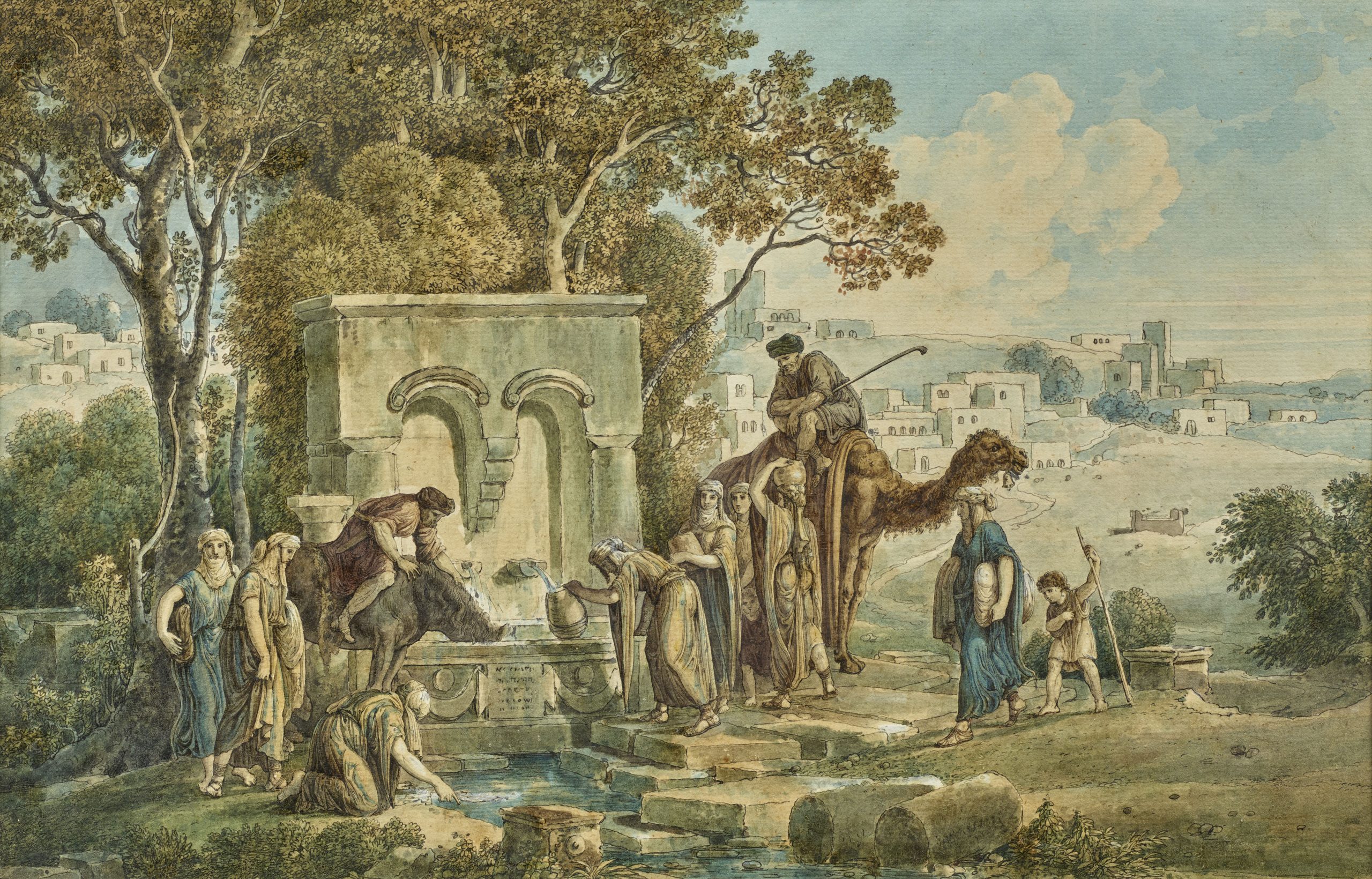
Louis-François Cassas, View of the Fountain of Cana in Galilee, watercolour and gouache, c. 1785-1790, Galerie Didier Aaron & Cie (fig. 1).
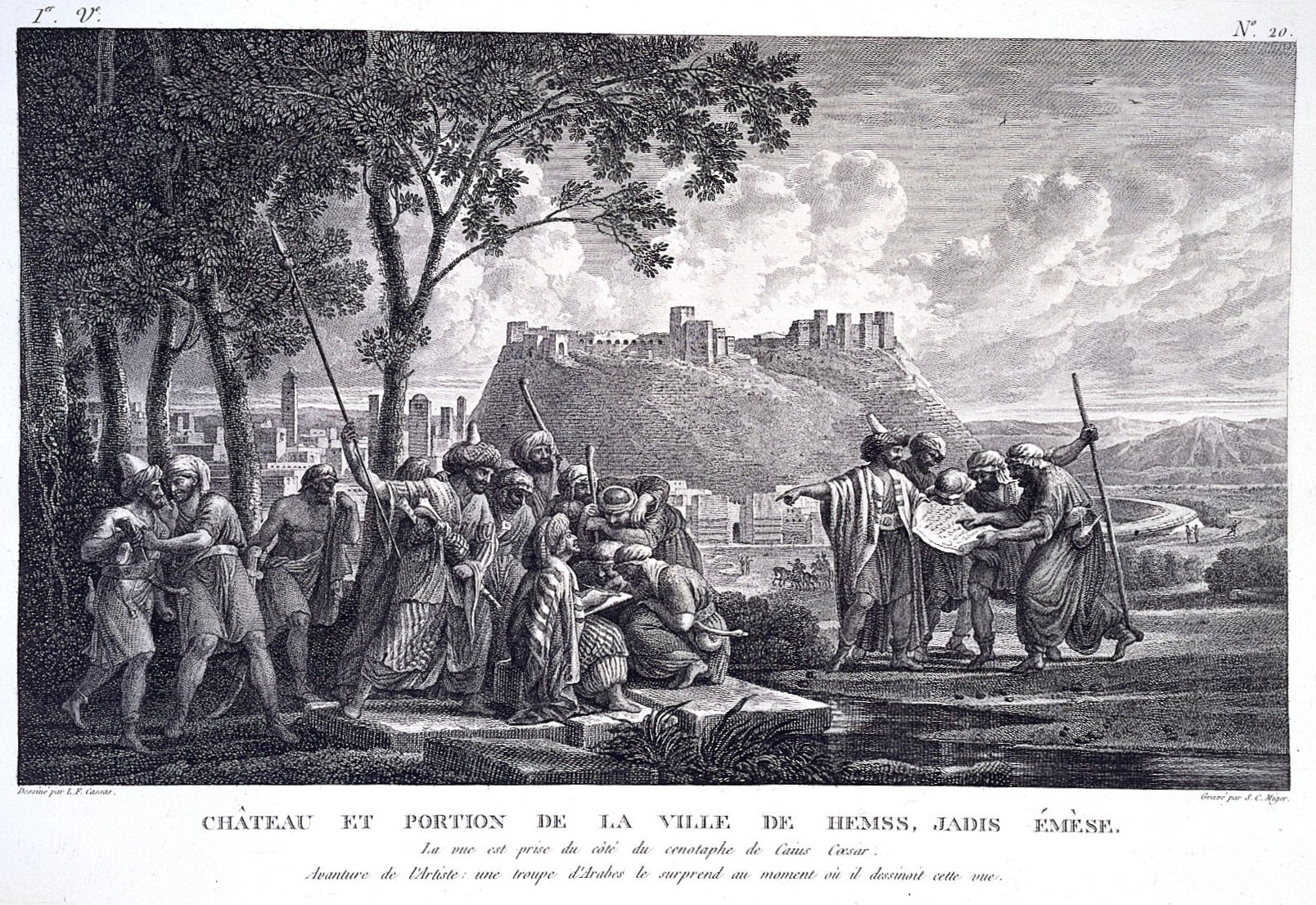
Simon-Charles Miger after Louis-François Cassas, Château et portion de la ville de Hemss, jadis Emèse, etching, in : Louis-François Cassas, Voyage pittoresque de la Syrie, de la Phénicie, de la Palestine et de la Basse-Egypte, vol. I, pl. 20, Paris, 1798 (fig. 2).
Cassas (here portrayed by Dominique Vivant Denon, 1786, Louvre Museum, detail) spent his early formative years in the Parisian residence of the Duke of Rohan-Chabot, where a drawing school had been established. Although the lessons of Vernet, Vien, Lagrenée, and Leprince were valuable to him, it was his stay in Italy from 1779 to 1783 that had the greatest influence on his career. In Rome and Campania, Cassas developed a growing interest in ancient sites and monuments. His talent for drawing was exceptional, and he worked tirelessly, traveling throughout Italy, Greece, and Dalmatia. A little later, he accompanied the Count of Choiseul-Gouffier to Constantinople, and for four years traveled across the Near East and Asia Minor, recording all the classical sites. At the beginning of the 19th century, he used his drawings to produce books about his travels. His career remains closely linked to the rediscovery of ancient civilizations, and his drawings, books, and engravings are also unique testimonies to this period.
In 1784, while he was in Constantinople with Choiseul-Gouffier, Cassas decided to set out for Syria and Egypt to gather a substantial collection of drawings in preparation for the publication of his Voyage Pittoresque, which was to appear in Year VI (1798). After only a few days on this new journey, and following a storm, Cassas’s ship—a corvette named Poulette—was forced to stop at Smyrna, where the artist received such a warm welcome that he stayed for nearly a month, including eight days in Ephesus drawing and measuring all the remains of the Temple of Artemis and the Gate of Persecution. It was while he was in Tripoli that Cassas decided to cross the Syrian desert to discover the famous ruins of Palmyra. An intrepid traveler, he equipped himself with special letters of recommendation from M. de Voize and the necessary gifts for the sheikhs. Dressed in oriental costume, wearing a beard, and, as was appropriate, well armed, Cassas joined a caravan in May 1785 in order to finally reach Palmyra.
Our watercolor depicts the first stage of his journey, when he stopped at Hemss, now called Homs, in Syria. This city lies at the gateway to the desert, about 150 km west of Palmyra.
In our view, Cassas chose to depict himself seated in the foreground, near a stream, pencil in hand, drawing the imposing citadel of Homs. As was his habit, the artist takes the opportunity to share his adventures. He is surrounded by a crowd of armed men whose expressions vary depending on their proximity to the traveler: while those farther away appear threatening or inquisitive, those closest prove to be intrigued and completely absorbed by the work in progress. This mise en abyme suggests that this may be a preparatory study for our watercolor.
Beyond the few trees that occupy the left side of the scene stretches the city of Homs, whose towers guide the viewer’s gaze toward the foot of the citadel, where the remains of an ancient gate seem to stand. Moreover, the caption of the etching indicates that this view of Homs was taken from the side of the cenotaph of Caius Caesar. Although not visible in our sheet but certainly nearby, Cassas is one of the rare individuals in history to have depicted this monument.
The French naturalist Pierre Belon (1517–1564) was among the first to take an interest in its inscriptions and concluded that it was the cenotaph of Augustus’s grandson, Caius Julius Caesar Vipsanianus (20 BC – AD 4). However, studies dating from the 19th century challenged this conclusion, favoring instead the hypothesis of a local builder, Caius Julius Alexion, a member of the local Sampsigeramid dynasty, which had been subdued by Pompey to the Roman Republic in the 1st century BC. Today, these remains no longer exist, as they were demolished in 1911 to construct an oil storage facility. As a result, Cassas’s representations, included in his Voyage pittoresque de la Syrie, de la Phénicie, de la Palestine et de la Basse-Égypte, constitute a rare record of the Roman past of the Syrian province.
This work is a remarkable collection of 330 plates, all engraved from drawings under Cassas’s direction. Our second sheet, View of the Fountain of Cana in Galilee (fig. 1), mentioned among the “related works,” also belongs to this publication: it is an original watercolor prepared as a study for one of the book’s etchings.
Monsieur de Choiseul-Gouffier, who had already financed the journey to Greece, covered the costs of the project. After his death in 1785, Anisson-Duperron, director of the Louvre printing house, took over responsibility for it, until the government in turn assumed control.
One may read in a prospectus printed in Year VI at the expense of the Republic: “Supporting the efforts of the author and wishing to uphold, together with him, the agreements successively made with the enthusiasts mentioned above, (the government) has undertaken to cover all the expenses required for the finest execution of the engravings of this work (…) already more than one hundred plates have been completed and two hundred others have been prepared in etching by the most skilled engravers, all of whom have been and continue to be employed on this enterprise…”
A note further confirms that “the government, convinced of the usefulness of this undertaking for the progress of the arts and of its close connection with the teaching of architecture and the interests of commerce, supported it with perseverance even amid the crises of the Revolution, by ordering at its own expense the engraving of the plates and the printing of the text.” The preparation of this text had been entrusted to the “citizens” Ginguené, a member of the Institut, for the historical section and the writing of the travel account; Legrand, architect, for the theoretical and descriptive aspects of architecture; and Langlès, also a member of the Institut, for the section on Oriental languages and inscriptions. Beginning in 1798, the work was published in monthly installments, each consisting of ten plates accompanied by their explanations.